What a Telegram Bot Specification Should Include: A Checklist with Examples
A good task description cuts both the estimate and the timeline of Telegram bot development: the less a developer has to guess, the less risk padding lands in the quote. Below is the 6-block checklist I ask clients to fill in before estimating a project. It also filters out the most common mistake — ordering "a bot in general" instead of a bot for a specific process.
1. The goal: which metric does the bot change?
One paragraph, without which everything else is pointless:
- Bad: "We need a bot for our salon."
- Good: "Clients book by phone; the receptionist spends 3 hours a day on it. The bot should handle 70% of bookings without a human."
The goal drives both the feature priorities and how we'll know the bot paid off.
2. Dialogue scenarios, step by step
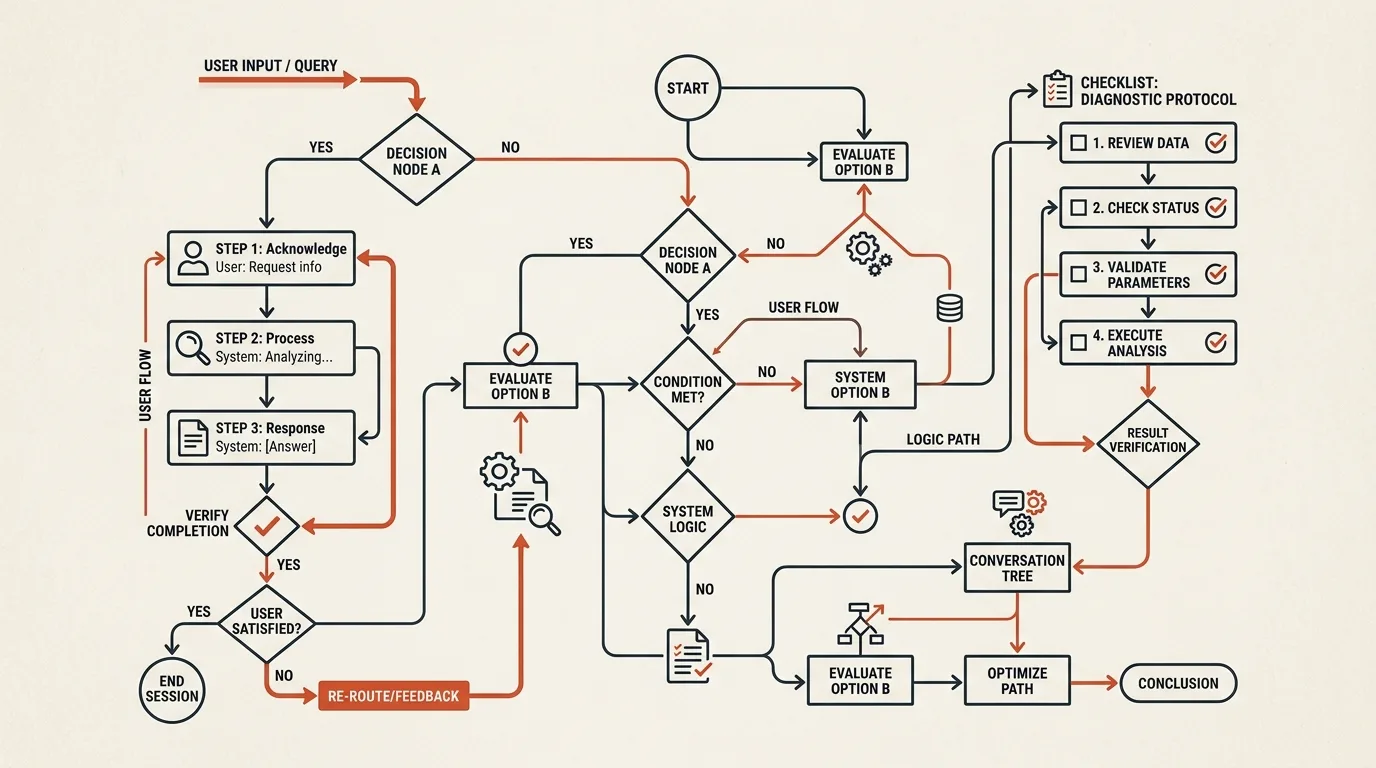
Describe 3–5 main scenarios the way a real client would walk through them:
Scenario "Book a service":
1. Client taps /start → greeting + menu [Book] [Prices] [Question]
2. [Book] → bot shows the service list (buttons)
3. Service chosen → bot shows available slots for the week
4. Slot chosen → bot asks for a phone number ("Share contact" button)
5. Confirmation → calendar entry + notification to the administrator
6. One day before the visit → automatic reminder to the client
This format answers most design questions by itself: which buttons, what data we collect, who gets notified.
3. Edge cases and errors
The block missing from 9 out of 10 briefs — and the one that defines bot quality:
- What does the client see when all slots are taken?
- What happens if the client abandons the dialogue midway and returns a day later?
- Who answers when the client asks a question outside the flow? (the AI-answers-from-knowledge-base option is covered in my RAG support bot breakdown)
- How does the client cancel or reschedule?
- What does the bot do on a failed payment?
4. Integrations and data
List the systems the bot must exchange data with, and in which direction:
If an integration is in-house (your own CRM or ERP), attach the API description or a contact who owns it. How a bot-to-CRM pipeline works technically is in my hands-on guide with code.
5. Roles and permissions
- Who administers the bot (edits texts, views leads)?
- Who receives notifications about new leads and payments?
- Is human handover needed, and who is that human during/outside business hours?
6. Non-functional requirements
Short, but explicit:
- Load: how many users per day do you expect (10? 1,000? 10,000?) — the architecture depends on it.
- Languages: one or several.
- Data: where personal client data lives, whether exports are needed.
- Platform limits: the Telegram Bot API rate-limits message sending — mass broadcasts are designed around those limits.
What happens to this brief next
The completed checklist is one or two pages of text. From it I prepare a specification with milestones and a fixed estimate (price benchmarks are in how much a Telegram bot costs), we approve it, and development runs with visible results every 3–5 days.
Ready to describe your task? Send the brief via the Telegram bot development page — I'll reply with an estimate within 24 hours. If the scenarios haven't taken shape yet, let's work through them together in a consultation.
Frequently asked questions
Do I need a formal specification, or can I describe the task in my own words?
Your own words are fine. A good brief is dialogue scenarios and a list of real customer questions, not a formal document. Turning it into a specification is my job at the briefing stage.
Who writes the final spec — the client or the developer?
The developer, based on your brief. You describe the business task and scenarios; I turn them into a specification with states, integrations, and staged milestones — and we approve it before development starts.
How detailed should the description be?
One or two pages is enough: the bot's goal, 3–5 step-by-step dialogue scenarios, a list of integrations, and examples of real customer questions. Detail beyond that rarely speeds up the project.
What if requirements change mid-project?
That's normal and expected. I show intermediate results every 3–5 days, so adjustments happen along the way, and larger scope changes become a separate stage so the estimate stays transparent.

Author
Alex RelFullstack Engineer
In commercial development since 2011 — over 15 years. Author of two SaaS products, TeleGo.io and LingvoHabit.com. The articles here come out of real client and product work.