nginx Builder: How Event-Driven Architecture Answered C10K
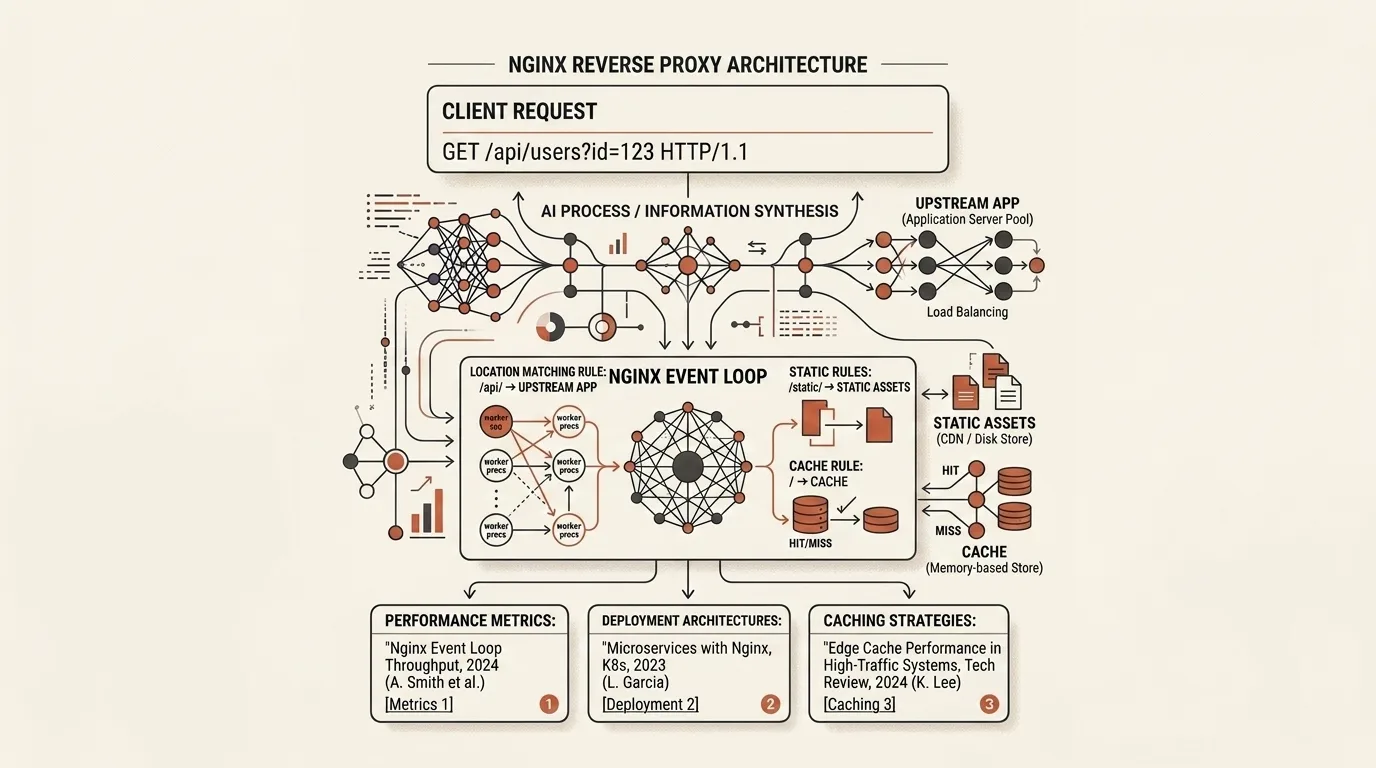
The web was changing quickly in the early 2000s. Pages were becoming heavier, audiences were growing, and an open connection increasingly spent most of its life waiting for data. That created a different kind of load because a server now had to do more than process each request quickly; it also had to keep thousands of client connections open without making every waiting client expensive. nginx emerged in that setting, with an architecture designed for high concurrency from the beginning.
C10K meant ten thousand connections, not ten thousand computations
In 1999, developer Dan Kegel began collecting notes under the title The C10K Problem, asking how one server could handle 10,000 clients. The number seems modest today, but it exposed a practical limit at the time. An idle connection performs almost no useful work, yet it still needs memory, a file descriptor, and an efficient way to wait for the next network event.
Concurrent connections should not be confused with application throughput. A server may complete ten thousand short requests in sequence and still struggle with ten thousand slow clients that send or receive a little data at a time. If every one of those clients occupies a process or thread, much of the machine's memory and scheduling effort goes into stacks, waiting, and context switches even though only a small fraction of the connections are ready to make progress.
What Apache 1.3 actually did
Retellings of this story often say that Apache 1.3 spawned a new process for every incoming connection. That is not quite right. On Unix, it generally used the model later called prefork: the parent maintained a pool of child processes in advance, and each available child accepted and served one connection at a time. This avoided launching a process for every request, but it preserved the important limitation that a slow client could occupy a dedicated executor for a long time.
The fair historical comparison is therefore "Apache 1.3 prefork versus event-driven nginx," not an eternal contest between two servers. Apache 2.0 made request processing modular, and the current Apache HTTP Server supports threaded worker and event MPMs. Modern Apache cannot be reduced to a process-per-connection diagram.
Why an event loop scales differently
Igor Sysoev began developing nginx in 2002 while working at Rambler and dealing with traffic on its services. Before building a separate server, he experimented with Apache modules including mod_accel, then moved to an independent implementation built around an asynchronous event loop. The nginx project history dates the first working prototype to the second half of 2003 and the public 0.1.0 release to October 4, 2004.
In nginx, a master process reads configuration, opens listening ports, and starts a small number of worker processes. Each worker monitors many sockets and returns to a connection when the operating system reports that it is ready to read or write. Linux normally provides epoll for this job, while BSD systems and macOS provide kqueue; the nginx documentation lists the other supported mechanisms.
A help desk offers a useful analogy. In a dedicated-executor model, one operator stays on the line with one customer even while that customer is silent and looking for paperwork. In an event-driven model, a smaller team is notified when a particular customer is ready to continue, so each operator can advance many conversations in turn. The connections still exist, but waiting no longer requires a separate process for each one.
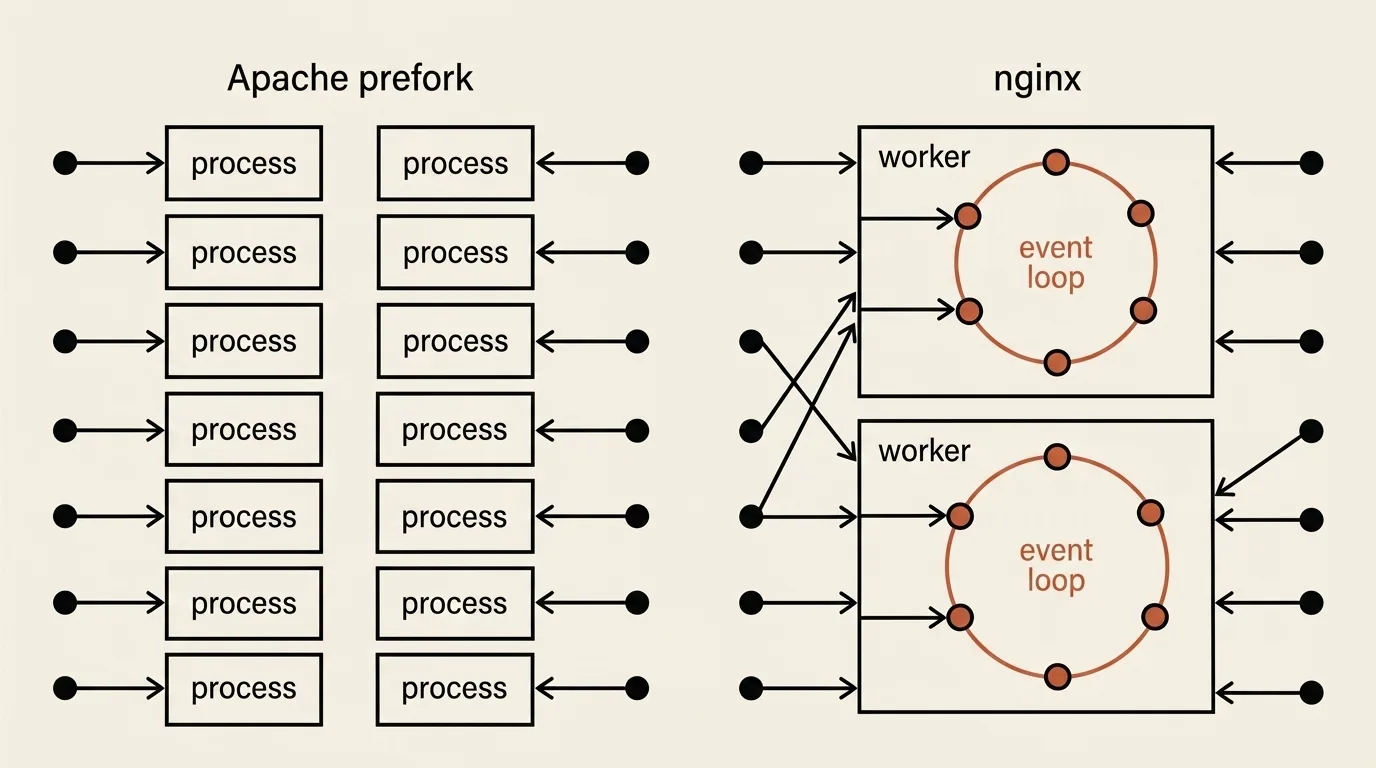
Nonblocking architecture does not make a server infinitely fast. File-descriptor limits, buffer memory, TLS work, disk performance, and the behavior of upstream applications remain real constraints. A blocking module inside a worker can also delay every connection assigned to that worker. nginx's advantage is narrower and more concrete: waiting for network readiness is usually much cheaper, as the nginx architecture guide explains through its master, worker, and event-loop model.
How nginx spread
Early deployments often did not replace Apache completely. Administrators placed nginx in front of it to serve static files, accept slow client connections, buffer responses, and proxy dynamic requests to the existing application server. This arrangement preserved a working application stack while removing the part of network handling that scaled poorly, so nginx adoption grew gradually through practical recommendations among system administrators.
In 2011, Sysoev founded NGINX, Inc. with Maxim Konovalov and Andrew Alexeev to support further development and commercial products. In March 2019, F5 announced an agreement to acquire the company at an enterprise value of about $670 million, then completed the transaction on May 9. In January 2022, Sysoev stepped away from NGINX and F5.
Reducing nginx adoption to one market-share number is not particularly helpful. Some surveys count every known domain, others examine active or high-traffic sites, and CDNs or proxies may conceal the application server behind them. It is accurate to call nginx one of the most widely deployed web servers and reverse proxies without turning a changing measurement into a permanent property of the software.
Why freenginx appeared
Open-source nginx continued under F5, but the question of who made final project decisions did not disappear. On February 14, 2024, long-time nginx developer Maxim Dounin announced freenginx. He attributed the fork to management interference with the project's established security policy and to his inability to remain responsible for changes made within F5.
freenginx did not replace nginx or bring its history to an end. It is a separate branch with its own governance and releases. The fork illustrates another consequence of infrastructure software becoming mature: technical architecture still matters, but it is joined by a governance architecture that determines development rules, security fixes, and the community's trust in the project.
What nginx Builder does
nginx Builder assembles a configuration without requiring you to remember where every directive belongs. It provides four starting points named Reverse Proxy, API Gateway, Static SPA, and High Traffic, then lets you choose between a standalone site config and a full nginx.conf before adjusting every option manually.
The form is divided into General, Upstreams, Routes, Security, Performance, and Advanced tabs. You can describe multiple upstream servers and a balancing strategy, add proxy, static, and fixed-response locations, and configure TLS, redirects, security headers, CORS, Gzip or Brotli, proxy caching, and per-IP rate limits. Advanced settings cover workers, connection limits, logs, DNS resolution, and custom directives.
The builder also respects directive context. It emits upstream, map, proxy_cache_path, and limit_req_zone at the HTTP level while keeping routes inside server and location. Options that depend on an external module or need an environment check appear in Notes. You can copy or download the generated file, but it still needs to pass nginx -t on the target server before a reload.
For a quick start, choose the closest preset, enter the domain and application address, then add routes and the security options you need. Review Notes, transfer the saved configuration to the server, and reload nginx only after nginx -t succeeds.
Related tools


Frequently asked questions
Who created nginx?
Igor Sysoev began developing nginx in 2002 while working at Rambler. He released the first public version on October 4, 2004, under a permissive BSD-like license. The name nginx is pronounced engine x.
What is the C10K problem?
C10K is the challenge of serving 10,000 concurrent client connections on one server. It concerns a large set of open connections, many of which may be waiting for data, rather than 10,000 computation-heavy requests consuming CPU time at once.
Why was nginx compared with Apache?
The historical comparison primarily concerned the prefork model common in the Apache 1.3 era: a pool of child processes handled one connection per child at a time. nginx let each worker monitor many connections through a nonblocking event loop. Modern Apache supports worker and event MPMs, so it is incorrect to say that every Apache configuration always dedicates a process to each connection.
When should I choose nginx or Apache?
nginx is often used for static files, reverse proxying, load balancing, and traffic controls. Apache may be a better fit when an application depends on .htaccess, particular modules, or an older deployment model. The answer depends on the configuration and workload; neither server is universally faster.
What is freenginx?
freenginx is an independent nginx fork launched by Maxim Dounin on February 14, 2024, after disagreements with F5 about open-source governance and security policy. nginx and freenginx have since continued as separate projects.

Author
Alex RelFullstack Engineer
In commercial development since 2011 — over 15 years. Author of two SaaS products, TeleGo.io and LingvoHabit.com. The articles here come out of real client and product work.