The Trap of Cheap Development: When to Rewrite Your SaaS MVP
Minimizing initial development costs is a primary goal for almost every bootstrapped startup founder. This desire often leads to hiring cheap freelance agencies or low-cost offshore developers to assemble the first version (MVP) of their SaaS platform.
The promise is attractive: a full-featured B2B application delivered for a fraction of the cost of a senior developer’s salary.
However, a high percentage of these projects run into a technical wall shortly after launch. Adding a simple dropdown menu breaks the billing integration, the application load time exceeds 8 seconds, and new developers refuse to touch the codebase, advising you to "rewrite everything from scratch."
In this management guide, we will analyze why the cheap development trap occurs, outline a technical rubric to diagnose if your codebase is salvageable, and look at the mathematical formula to choose between refactoring and rebuilding.
The Economics of Low-Cost Development
When an agency charges $20-$30/hour to build a complex SaaS, they must optimize their own margins to survive. They achieve this in three ways:
- Hiring Junior Developers: The project is designed and written by engineers with minimal architectural experience.
- Skipping Quality Controls: Zero unit tests, integration tests, or API documentations are created. The only quality assurance is manual testing by the developers themselves.
- Using Rigid Boilerplates: The application is built on top of outdated templates or custom-patched WordPress/No-Code systems that are impossible to scale or integrate with modern APIs.
The result is massive technical debt accumulated from day one. You save money upfront, but you pay a high premium in developer friction and slow features velocity post-launch.
1. Technical Health Rubric
To make an objective decision rather than relying on gut feelings, perform a technical check of your MVP against these key metrics:
2. Refactor vs. Rebuild: The Financial Calculation
To determine the best path forward, calculate the Refactoring Coefficient (K):
K = (C_audit + C_tests + C_db + C_logic) / C_rebuild
Where:
- K: Refactoring Coefficient (the threshold of feasibility).
- C_audit: Cost of auditing and identifying all hidden bugs in the current legacy code.
- C_tests: Cost of writing unit/integration tests to ensure refactoring does not break existing features.
- C_db: Cost of migrating and fixing the database schema without losing existing customer records.
- C_logic: Cost of isolating business logic into clean services.
- C_rebuild: Cost of rebuilding the same feature set from scratch using a modern, scalable architecture (like Nuxt 3 + Node.js).
The Decision Rule:
- If K < 0.5: Refactoring is the logical choice. The foundation is solid; it just needs cleanup.
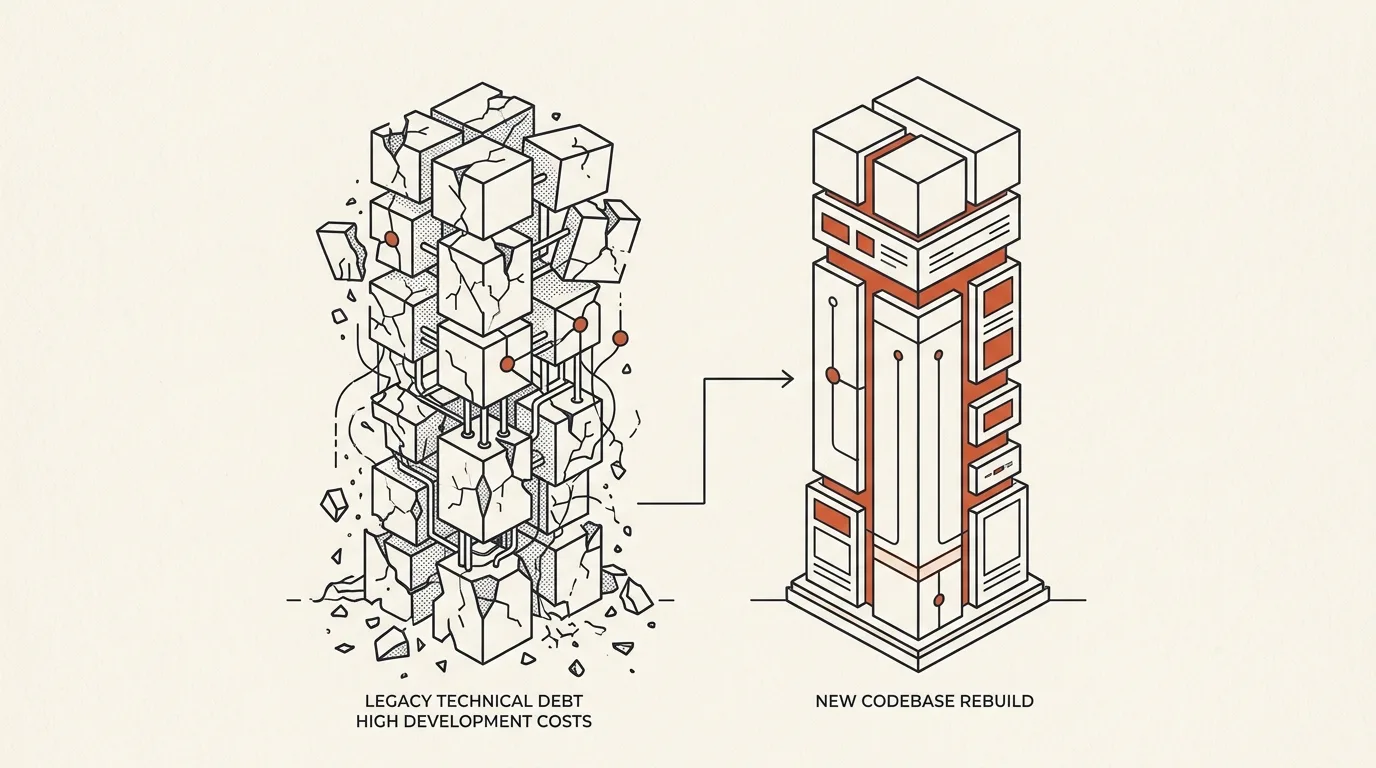
- If K >= 0.7: Rewrite the application. Attempting to patch a deeply flawed codebase will cost more time and money than starting fresh. It is similar to trying to fix a crumbling house foundation—you will spend more patching cracks than you would rebuilding.
3. How to Protect Your Next Development Run
If you decide to rebuild, implement these checks to prevent falling into the same trap again:
- Establish Code Ownership: Ensure all source code is hosted on your GitHub organization from day one, with branch protection rules requiring code reviews before merge.
- Mandate Static Analysis: Require the team to use automated tools (like ESLint or Biome) and maintain at least 70% test coverage on critical business logic.
- Perform Early Audits: Do not wait until week 20 to review the code. Hire an independent technical consultant to perform a code audit in week 2 or 3 of development to catch architectural mistakes early; you can read my complete Codebase Audit Checklist to learn how to structure this check.
Sources and documentation
- Martin Fowler: Technical Debt — the canonical definition of technical debt and its quadrants
- OWASP Top 10 — the vulnerabilities most often found in "cheap" codebases
If you are dealing with a slow, bug-ridden MVP, struggling with low developer velocity, or need a professional assessment of your codebase's health, visit my SaaS Development Service page or book a Technical Consultation to receive an audit.
Frequently asked questions
How do I quickly tell whether an MVP will need a rewrite?
Four red flags: no relations or indexes in the database, business logic and secret keys sitting inside client-side components, dependencies that are abandoned or hand-patched in node_modules, and errors silenced by empty try/catch blocks with no logging. Two or more flags almost always means a rewrite.
When is refactoring cheaper than rebuilding?
When the combined cost of the audit, tests, database fixes, and logic extraction is under half the cost of building from scratch (coefficient K_R < 0.5). At K_R ≥ 0.7 a rewrite wins: patching a crumbling foundation consumes more resources than pouring a new one.
How do I avoid the same trap with the next contractor?
Keep the code in your own repository with protected main and mandatory reviews, require linters and 70%+ test coverage on critical logic, and order an independent architecture audit in week 2–3 of development — not after release.

Author
Alex RelFullstack Engineer
In commercial development since 2011 — over 15 years. Author of two SaaS products, TeleGo.io and LingvoHabit.com. The articles here come out of real client and product work.