Codebase Audit Checklist: How to Assess Technical Debt Before Scaling
Taking over a legacy codebase, acquiring an existing SaaS startup, or preparing a MVP for a major scaling phase is a critical turning point. In these scenarios, technical debt is your biggest invisible enemy.
Code that appears to function perfectly on a developer's machine can harbor security vulnerabilities, lack proper database indices, or contain architectural flaws that make adding new features take weeks instead of days.
To scale safely and prevent expensive rewrite cycles, you must perform a thorough codebase audit.
In this senior developer guide, we present a technical playbook for auditing Node.js/TypeScript applications, identifying DB bottlenecks (like the N+1 query problem), checking security controls, and organizing a refactoring plan.
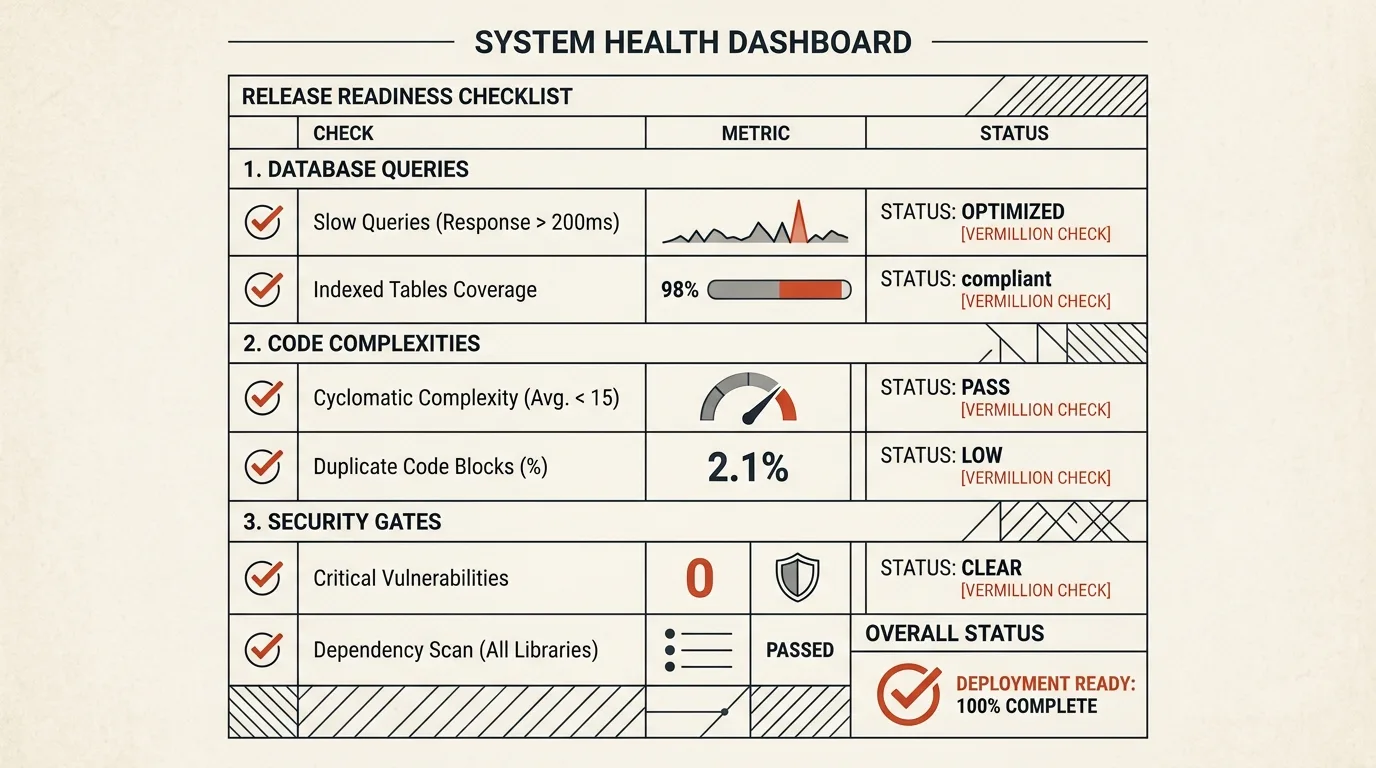
1. Automated Meticulous Metrics Check
Before looking at custom business logic, gather quantitative metrics using specialized analysis tooling. This sets a baseline for your engineering teams:
2. Technical Audit: Crucial Checkpoints
A. The Database Layer: Solving the N+1 Query Problem
A common scaling bottleneck is the N+1 database query pattern. This occurs when your backend queries a database to retrieve a list of records, and then runs separate queries for each retrieved record to fetch associated relationships.
The Bad Pattern (N+1 Query in Express API)
// GET /api/projects - Pulls N projects, then makes N database calls to get users
app.get('/api/projects', async (req, res) => {
  const projects = await db.query('SELECT * FROM projects'); // 1 Query
  const enrichedProjects = [];

  for (const project of projects) {
    // RUNS N TIMES! If you have 1000 projects, this runs 1000 queries.
    const user = await db.query('SELECT * FROM users WHERE id = $1', [project.userId]);
    enrichedProjects.push({ ...project, user });
  }

  res.json(enrichedProjects);
});
The Optimized Pattern (SQL Joins)
Combine these into a single database execution:
app.get('/api/projects', async (req, res) => {
  const query = `
    SELECT p.*, row_to_json(u.*) as user
    FROM projects p
    LEFT JOIN users u ON p.userId = u.id
  `;
  const result = await db.query(query); // 1 Single Query instead of N+1
  res.json(result.rows);
});
B. Secret Management and Environment Parity
Check where API tokens, private keys, and passwords are stored.
- Zero Hardcoding: Ensure no
.envfiles or raw strings are committed to Git. Usegit-secretsor Snyk to scan Git history for leaked credentials. - Configuration Validation: Use a library like
zodto validate that all required environment variables are set at startup:
import { z } from 'zod';

const envSchema = z.object({
  DATABASE_URL: z.string().url(),
  PORT: z.string().transform(Number),
  STRIPE_SECRET_KEY: z.string().min(10),
});

export const ENV = envSchema.parse(process.env);
C. Security and Input Sanitization
Inspect HTTP route entrypoints.
- SQL Injection Prevention: Ensure the codebase never concatenates strings directly into SQL statements (e.g.,
db.query("SELECT * FROM users WHERE id = " + userId)). Always utilize parameterized queries (db.query('SELECT * FROM users WHERE id = $1', [userId])) or verified ORMs. - HTTP Security Headers: Verify that the application uses the
helmetpackage to automatically inject security headers (CSP, HSTS, X-Frame-Options) to protect against cross-site scripting (XSS) and clickjacking.
3. Organizing the Refactoring Plan
After completing the codebase audit, document the technical debt and prioritize fixes into three buckets:
- Blocker Issues (P0): Security risks, hardcoded API secrets, lack of backups, or broken authentication layers. Fix immediately before writing new features.
- Performance Bottlenecks (P1): Missing indexes on primary DB keys, N+1 queries, or slow third-party API calls lacking cache layers. Plan to refactor in the next sprint.
- Technical Debt Cleanup (P2): Formatting errors, lack of comments, code duplication, and low test coverage. Allocate 20% of every development sprint to address these.
Sources and documentation
- OWASP Top 10 — the reference list of web vulnerabilities for the security block
- npm audit — checking dependencies for known vulnerabilities
- PostgreSQL: Indexes — the official indexing guide
Regular technical codebase audits are key to maintaining developer velocity, reducing server overhead, and ensuring your SaaS scales seamlessly. Performing these audits is especially important if you suspect your code was rushed by budget agencies; read my analysis on The Trap of Cheap Development: When to Rewrite Your SaaS MVP.
If you are taking over a project and need a professional third-party code audit, an architectural review, or want to establish code quality rules for your engineering team, visit my Technical Consultations Service page or book a session.
Frequently asked questions
When does a codebase need a technical audit?
At three critical points: taking over a legacy project from another team, acquiring an existing product, and right before an active scaling phase. An audit in week 2–3 of a new project is cheaper than any audit after release.
What gets checked first?
Automated metrics first (dependency vulnerabilities via npm audit, linting, test coverage), then manual points: parameterized SQL queries, indexes on foreign keys, N+1 patterns, secrets in the repository, and error handling.
What do I do with the findings?
Split them by priority: P0 — security and backups, fix immediately; P1 — performance (indexes, N+1, caching), next sprint; P2 — code cleanup, a steady 20% of every sprint.

Author
Alex RelFullstack Engineer
In commercial development since 2011 — over 15 years. Author of two SaaS products, TeleGo.io and LingvoHabit.com. The articles here come out of real client and product work.