Docker Toolbox: How Docker Made Containers Practical
Docker is often credited with bringing containers into mainstream software development, although the isolation mechanisms themselves are much older. Its defining contribution was not a new way to restrict a process. Docker connected application builds, dependencies, image distribution, and one-command execution into a coherent workflow, turning a collection of operating-system facilities into something an application developer could use directly.
Containers existed long before Docker
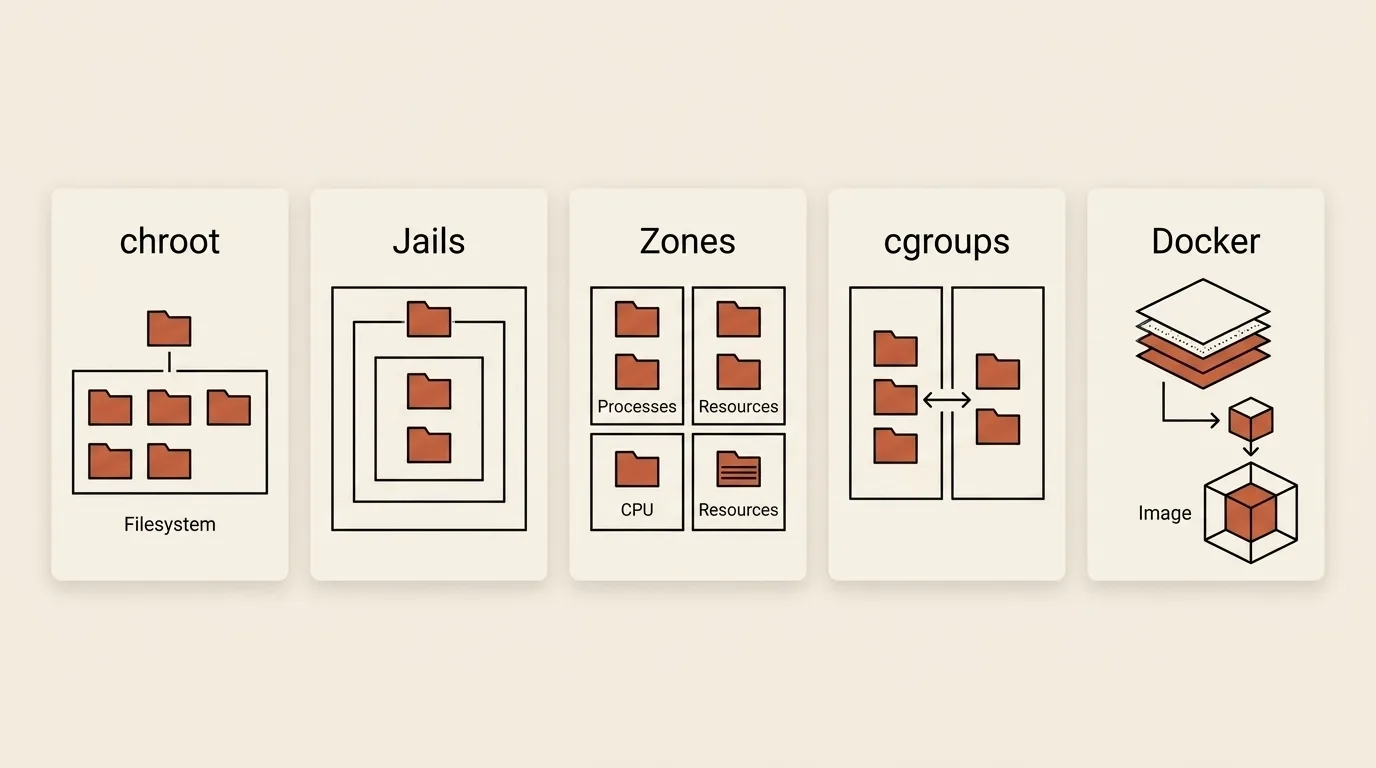
One early ancestor was chroot, included in Version 7 Unix in 1979. It changes the root directory visible to a process and can separate one filesystem view from another, but it does not isolate every process, network resource, or other part of the host. That makes chroot a useful building block rather than a complete security boundary.
Later systems extended isolation beyond the filesystem. Jails, introduced with FreeBSD 4.0, provided separate views of users, processes, and networking. Solaris Zones developed a similar idea into a managed form of operating-system virtualization. Unlike a virtual machine, these environments do not boot an independent kernel. Their processes continue to share the host kernel, which usually reduces overhead but also ties their compatibility and security model to that common kernel. Modern containers retain the same fundamental tradeoff.
On Linux, a container emerged from several kernel mechanisms developed over multiple releases rather than from one container switch. Namespaces give a group of processes a private view of process IDs, mount points, networks, users, and other system resources. Control groups, usually called cgroups, organize processes hierarchically and let the system account for or limit resources such as memory and CPU time. Namespaces primarily answer “what can this process see?”, while cgroups answer “how much may it use?” A practical container also needs capabilities, networking rules, a filesystem, and additional security controls.
By the end of the 2000s, LXC had assembled these Linux features into user-space libraries and commands for creating containers. It was already a capable and useful toolkit, so describing it as merely “almost Docker” misses the distinction. LXC was principally designed to create an environment resembling a separate Linux system. Docker would instead focus its workflow on packaging and delivering a particular application.
The problem inside dotCloud
Solomon Hykes founded dotCloud to build a platform as a service that could run customer applications written in different languages with different dependency stacks. Isolation solved only part of that platform's problem. The team also needed a repeatable way to accept an application, construct its environment, move the resulting artifact between machines, and start it consistently without requiring every customer to understand LXC or host configuration.
The team extracted the solution it had developed inside dotCloud into an open-source project. On March 15, 2013, Hykes gave the first public Docker demonstration at PyCon and framed the problem in practical terms: shipping code to a server was hard for developers. Early Docker releases used LXC as their execution environment, but Docker was more than a friendlier command wrapper around it. The project introduced its own image model and a common interface connecting an application's build, storage, transfer, and execution.
What Docker actually changed
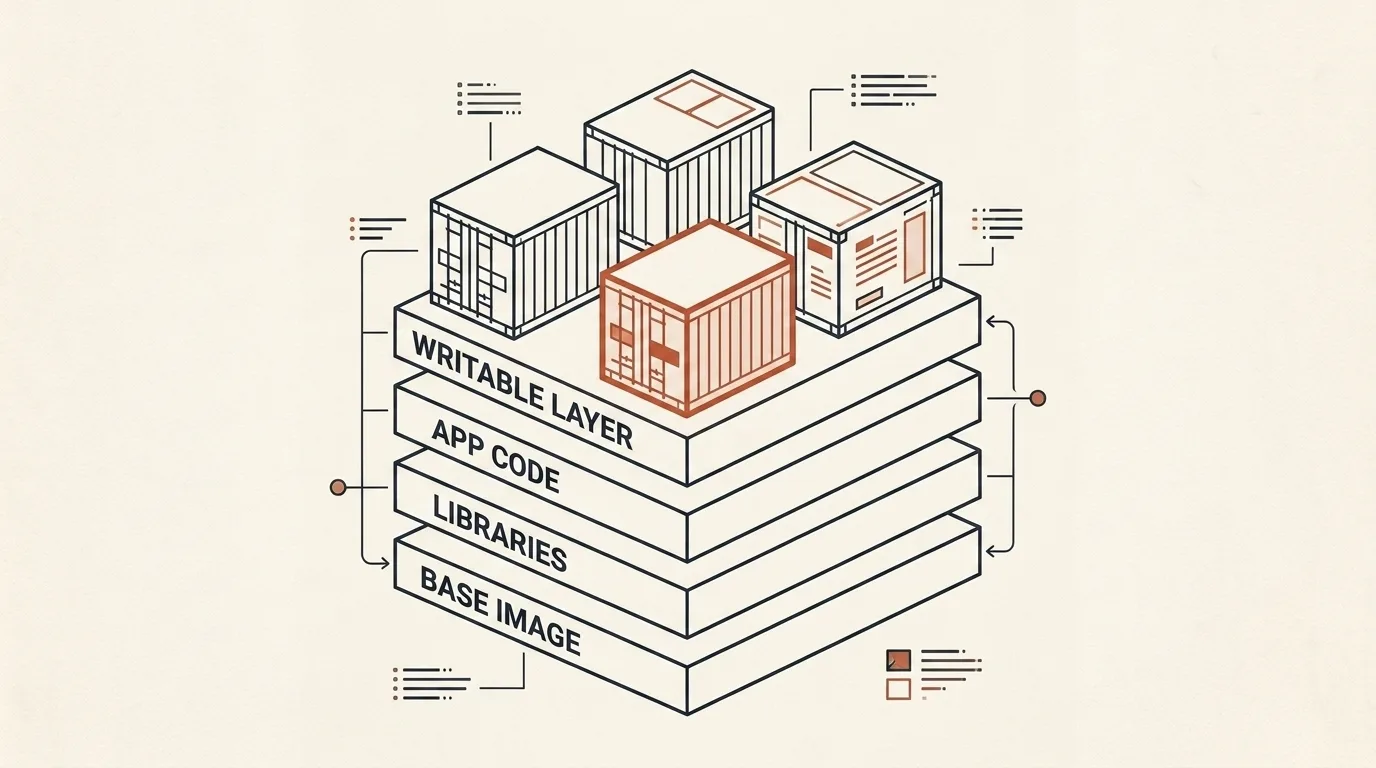
Docker's usability came from the combination of several ideas. A Dockerfile put the environment recipe beside the application code so that a build could be repeated instead of reproduced by hand on a server. Image layers allowed unchanged work to be reused and cached. A registry gave images a shared address, making push and pull a natural way to move the same artifact between a laptop, CI, and a server. Finally, commands such as docker build and docker run hid much of the underlying system configuration behind a short and reasonably consistent interface.
These pieces did not all arrive in the first public demo. Docker's release history records the Dockerfile builder in version 0.4 in June 2013, while the central registry and support for running a private registry were evolving during the same year. Docker Compose grew out of the separate Fig project and joined the ecosystem later, so docker compose up should not be counted among Docker's original 2013 innovations.
The implementation underneath that workflow changed as well. In March 2014, Docker 0.9 made libcontainer its default execution driver. The new library worked directly with Linux namespaces, cgroups, capabilities, and networking instead of requiring LXC. This transition illustrates why Docker and containers are not synonyms: the user-facing build and run workflow survived even when the underlying runtime implementation was replaced.
The practical result mattered more than any single command. A developer had a transportable artifact with explicit dependencies, CI could test the same image that would be placed in a registry, and a server could start it from the same instructions. This did not erase differences in CPU architecture, kernel configuration, secrets, storage, or networking, so “runs anywhere” has always come with conditions. It did, however, remove many of the accidental differences between environments.
From one product to shared standards
As the container ecosystem expanded, tying image formats and runtime behavior to one vendor became a risk. In June 2015, Docker, CoreOS, and other companies launched the Open Container Initiative under the Linux Foundation. Docker contributed its container format and runC, and the effort developed open runtime, image, and distribution specifications.
OCI does not make every container tool interchangeable. Docker, containerd, Podman, CRI-O, and orchestrators still address different layers of the problem and provide different features. The specifications define compatible boundaries between an image, its distribution, and its runtime, allowing that image to outlive any one implementation. Docker's lasting influence therefore reaches beyond the popularity of docker run: it helped establish the container image as a portable unit of application delivery.
What Docker Toolbox does
Docker Toolbox does not build images. Its primary mode parses an existing docker run command and converts supported options into a docker-compose.yml service. The converter currently understands the container name and image, published ports, mounted volumes, environment variables, and the restart policy.
The second mode is a compact maintenance reference. It provides commands for pruning unused Docker resources, stopping and removing all containers, opening a shell in a selected container, and following recent log output. Cleanup commands deserve a careful review before execution: docker system prune -a --volumes, for example, removes unused images, networks, and volumes in addition to stopped containers.
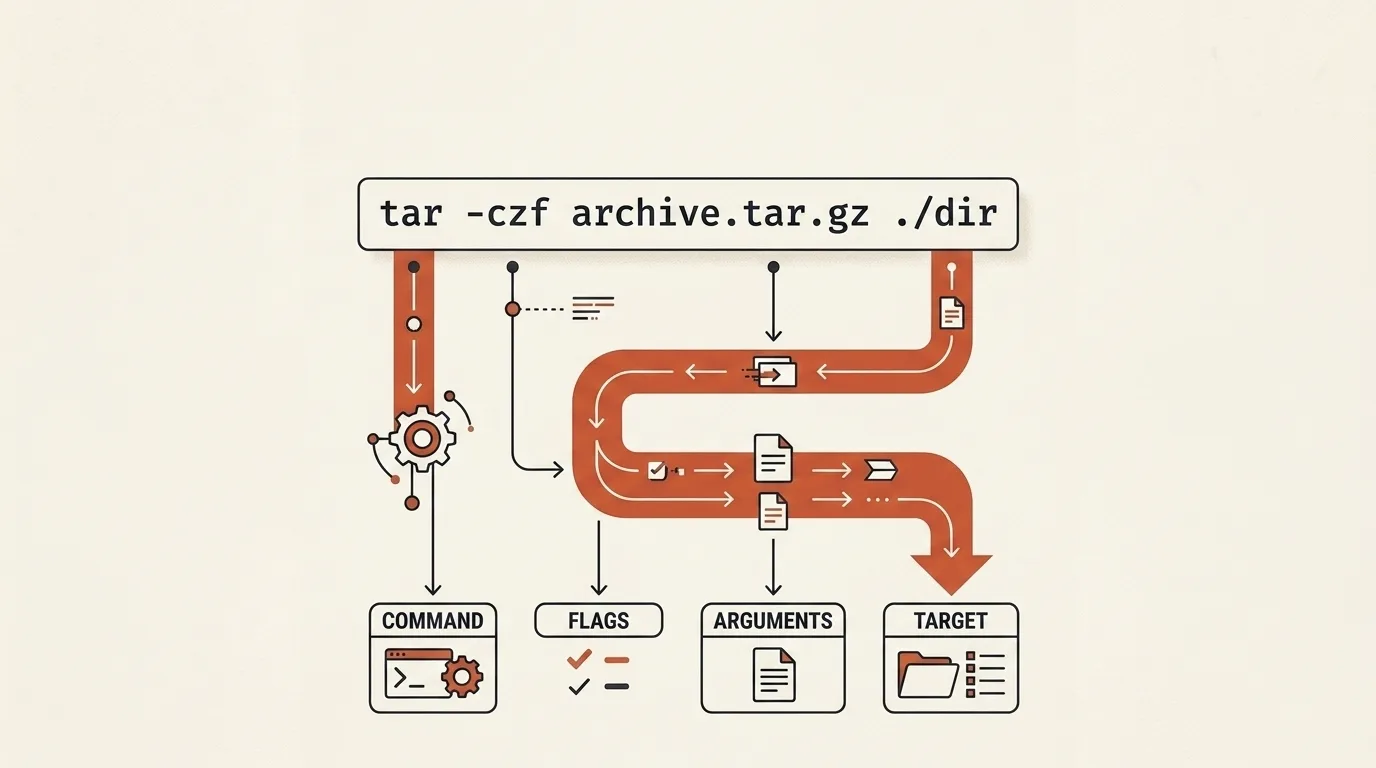
For a quick conversion, paste a command such as docker run -d --name web -p 8080:80 -e NODE_ENV=production nginx:alpine. The tool generates a Compose service carrying over the image, port, name, and environment variable. You can copy that result and then add networks, dependencies, or any settings that were not represented by the original command.
Related tools


Frequently asked questions
Who created Docker?
Docker was created by Solomon Hykes and the team at dotCloud. The project was first demonstrated publicly at PyCon on March 15, 2013, then developed in the open with a growing community of contributors.
How is a container different from a VM?
A virtual machine runs a separate guest operating system with its own kernel. A conventional Linux container shares the host kernel and relies on kernel facilities to isolate its processes. Containers therefore tend to start faster and use fewer resources, but their isolation boundary is different from that of a virtual machine.
What is the history of containerization?
Modern containers were preceded by Unix chroot, FreeBSD Jails, Solaris Zones, and the Linux namespaces and cgroups mechanisms. LXC assembled Linux kernel facilities into a user-space toolkit, while Docker added an application-focused workflow for building, storing, transferring, and running images.
What is Docker Compose?
Docker Compose describes a multi-container application in YAML, including its services, networks, volumes, and runtime settings. The docker compose up command creates and starts that set as one application. Compose arrived after Docker's initial release and was not part of the feature set demonstrated in 2013.
What is the Open Container Initiative (OCI)?
The Open Container Initiative was established under the Linux Foundation in 2015 to create open standards for container images, runtimes, and distribution. These specifications allow different compatible tools and runtimes to understand the same image.

Author
Alex RelFullstack Engineer
In commercial development since 2011 — over 15 years. Author of two SaaS products, TeleGo.io and LingvoHabit.com. The articles here come out of real client and product work.