XML Toolbox: When JSON Falls Short
In a world where JSON is the lingua franca of APIs, XML can seem like a relic of the past. But it carries deep engineering thought, and no enterprise integration can do without it.
SGML: the father of markup (1969)
In 1969, Charles Goldfarb, Ed Mosher, and Ray Lorie at IBM were looking for a way to store legal documents so they could be processed on different machines. They created GML (Generalized Markup Language) — and, conveniently, the name matched their initials: Goldfarb, Mosher, Lorie. GML grew into the ISO 8879 standard in 1986: SGML.
SGML is a meta-language: it doesn't define specific tags, but sets rules for creating markup languages. From SGML came:
- HTML — Tim Berners-Lee, 1991
- XML — W3C, 1998
- DocBook — technical documentation
XML: SGML for the web (1998)
By the mid-1990s, SGML was too complex for the web. Browsers couldn't parse full SGML. In 1996, Jon Bosak of Sun Microsystems led a W3C working group to create a simplified version.
On February 10, 1998, XML 1.0 became a W3C recommendation. Key differences from SGML:
- Strict syntax (no optional closing tags)
- Clear parsing rules
- Unicode support from day one
XML took off immediately: by 2000, it powered web services (SOAP, WSDL), RSS feeds, SVG, XHTML, office formats, and Java/Android app configurations.
XML vs JSON: passing the torch
In 2001, Douglas Crockford "discovered" JSON — a format radically simpler than XML for data exchange between server and browser. By the mid-2010s, JSON had practically pushed XML out of REST APIs.
But XML didn't die — it found its niche:
- XSD — stricter schemas than JSON Schema
- XSLT — XML → HTML, PDF transformation
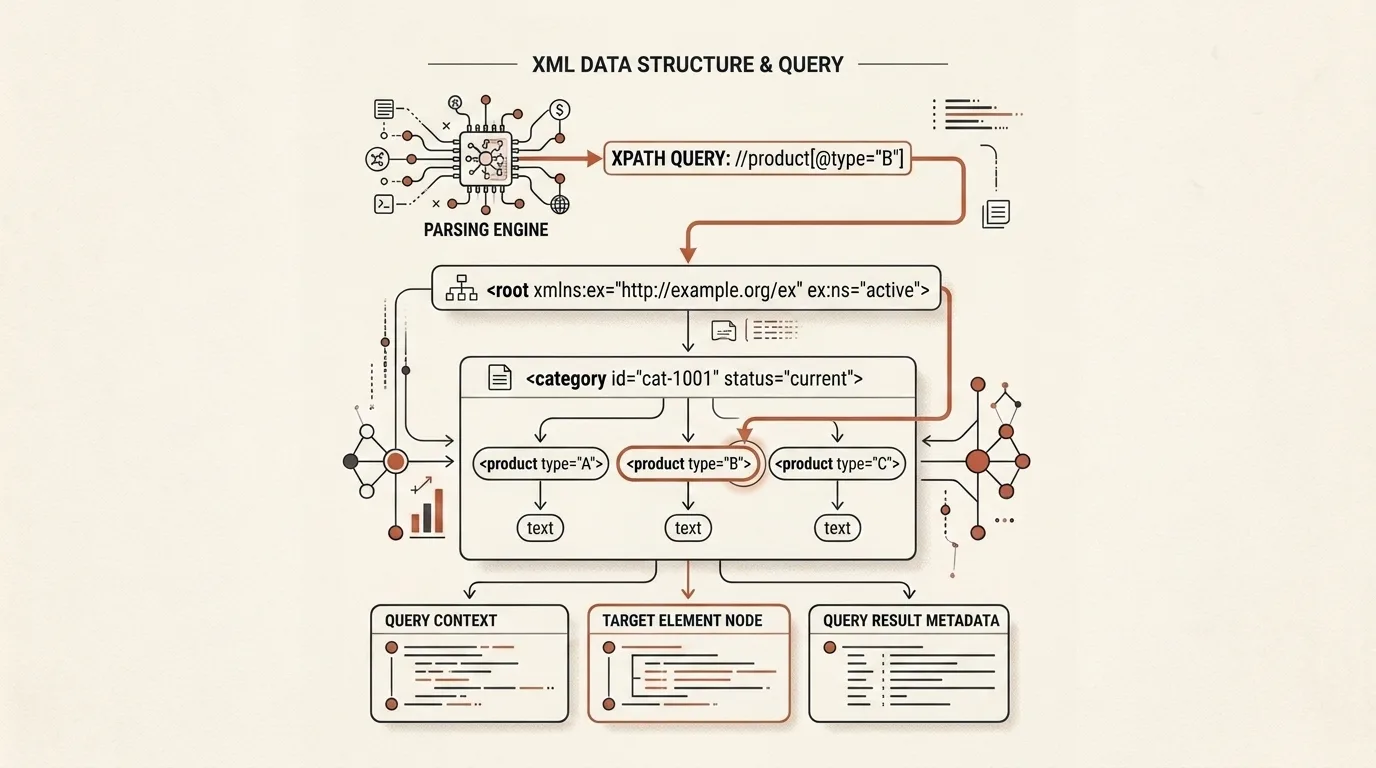
- XPath — powerful queries into DOM-like documents
- Namespaces — mixing different vocabularies in one document
The scale is easy to miss: every .docx, .xlsx, and .pptx is a ZIP archive full of XML, every SVG icon is XML, and every Android layout is XML. JSON won the API — XML quietly runs the documents.
What XML Toolbox does
XML Toolbox is a universal tool for working with XML:
- Formatter — pretty-print XML with proper indentation
- Minify — compress to a single line
- JSON ↔ XML — bidirectional conversion
- Validation — XML syntax checking
- Statistics — element count, attributes, nesting depth
Quick start: open the tool → paste any XML → click Format → see a clean tree → click To JSON — get the equivalent in JSON format.
Related tools


Frequently asked questions
When was XML created?
XML (eXtensible Markup Language) became a W3C recommendation on February 10, 1998. It was created by a working group led by Jon Bosak of Sun Microsystems. XML was a simplified version of SGML (ISO 8879, 1986) — a complex markup standard used in aviation, defense, and publishing.
Who invented SGML?
SGML (Standard Generalized Markup Language) was developed by Charles Goldfarb of IBM in 1969. It became the international standard ISO 8879 in 1986. SGML gave birth to both HTML (Tim Berners-Lee, 1991) and later XML.
How does XML differ from JSON?
XML is a markup language with attributes, namespaces, and schemas (XSD). JSON is a lightweight data format based on JavaScript. XML is stricter: requires closing tags, supports comments, XSLT, and XPath. JSON is simpler, faster to parse, and more readable. For APIs, JSON is the modern standard; for documents with complex structure, XML is preferred.
What is XSLT?
XSLT (XSL Transformations) is a language for transforming XML documents into other formats (HTML, PDF, Plain Text). A W3C recommendation since 1999. XSLT uses templates and XPath for element selection. For example, XSLT can convert an XML product catalog into an online store HTML page.
Where is XML still irreplaceable?
XML remains the standard in: SOAP web services, SVG graphics, RSS/Atom feeds, XHTML, Android app configurations, office document formats (OOXML, ODF), exchange protocols (FIXML), and enterprise A2A integrations (SAP, Oracle).