Why Denso Wave Made QR Codes Free to Use
QR codes have become an ordinary bridge between a physical object and a digital action. We point a camera at a menu, ticket or package and rarely notice how many engineering decisions sit inside the small grid. Its story did not begin with smartphones or payments. It began with a factory problem: workers needed to read more information, more quickly, than a conventional barcode could hold.
The decision made after development proved just as important. Denso did not abandon all of its patents, but it published the specification and allowed standardized QR Code to be used freely. That distinction sounds legalistic, yet it explains how a corporate technology became a shared international format.
Manufacturing had outgrown one barcode
In the early 1990s, automotive production was moving from long runs of identical products toward flexible manufacturing of many variants. More information had to travel with parts and finished goods. According to Denso's history, a linear barcode held about twenty alphanumeric characters, so workers sometimes had to scan roughly ten codes on one product. Oil contamination could make those labels harder to read as well.
Masahiro Hara and one other engineer began working on a replacement in 1992. It is worth keeping the corporate timeline straight: they were part of Denso Corporation at the time, and Denso Wave became a separate company after the business was spun off in 2001. The team wanted high capacity, support for kanji and kana, a compact footprint and fast recognition.
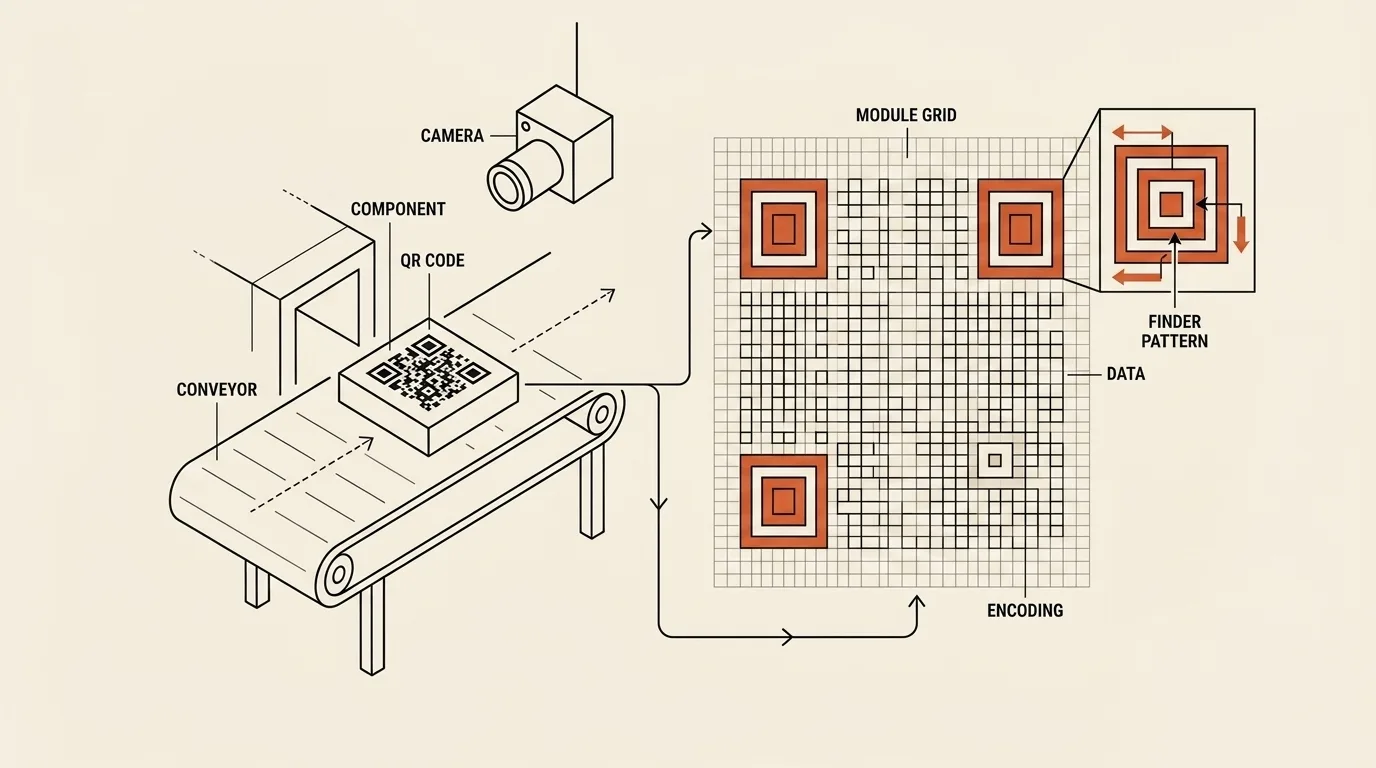
The hardest problem was not simply putting data in two dimensions. Other 2D codes already existed, but a scanner still had to find the symbol quickly among text, borders and other printed marks. Hara proposed adding dedicated position markers. The team then surveyed patterns in newspapers, magazines, leaflets and packaging to find a black-and-white sequence that appeared rarely. The result was the 1:1:3:1:1 ratio found across each large corner square. A scanner can search for that ratio to locate the code and determine its rotation.
The game of Go is often turned into a single eureka story, as though the sight of black and white stones immediately supplied the finished matrix. Hara has indeed described Go as one source of his thinking: the position of stones remains recognizable from context even when a pattern is imperfect. The detailed Denso Wave development history, however, traces the finder pattern to the separate problem of rapid location and the measurement of rare black-and-white proportions. Both parts belong in the story, but they should not be compressed into a tidy myth.
After a year and a half of development, the design was ready. Denso announced Quick Response Code in 1994, and its name stated the main priority plainly: fast reading.
The patents stayed, but standardized QR Code was opened
The familiar line that Denso “gave QR Code to the world” captures the broad effect while skipping the mechanism. The company retained patent rights and publicly promised not to exercise them against standards-compliant QR codes. Other companies could obtain the specification and build compatible readers, printers and software without negotiating a separate Denso Wave licence.
Standardization happened in stages. QR Code became an AIM International standard in 1997, entered JIS in 1999 and was accepted as ISO/IEC 18004 in June 2000. The current fourth edition at the time of writing, ISO/IEC 18004:2024, covers symbol structure, data-encoding methods, dimensions, error-correction rules, a reference decoding algorithm and production-quality requirements.
The promise also has a boundary. On its standardization page, Denso Wave identifies patent JP2938338 and speaks specifically about standardized QR codes. A non-standard design may involve other rights, and the words QR Code are a registered trademark. Ordinary creation and commercial use of a symbol conforming to JIS or ISO requires no application, licence contract or fee paid to Denso Wave.
A QR symbol contains functional geometry and a data stream
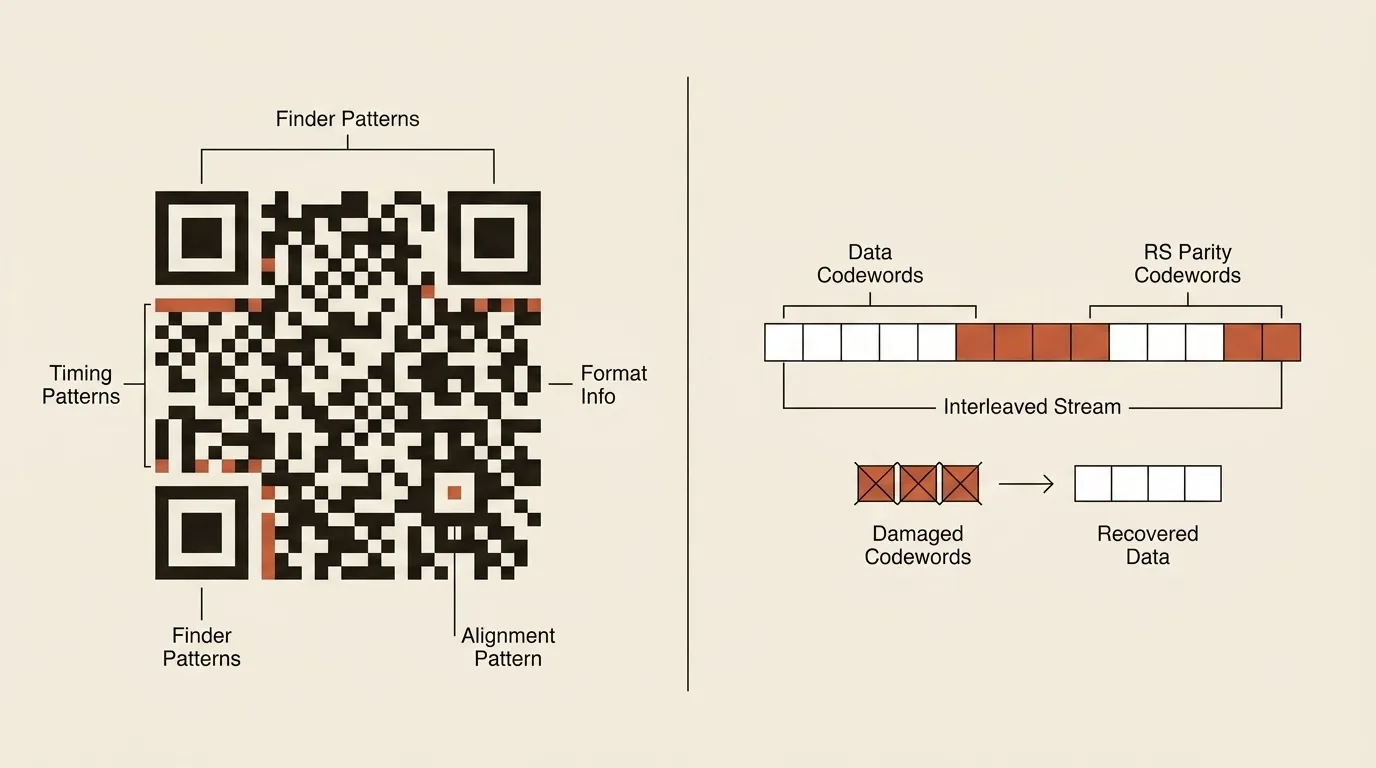
The black and white squares are called modules, but not every module carries a piece of the link or text. A light quiet zone at least four modules wide surrounds a normal QR symbol. Three finder patterns locate and orient it, timing patterns establish the rhythm of rows and columns, and alignment patterns from Version 2 onward help compensate for geometric distortion. Nearby format information records settings including the error-correction level and mask.
The remaining region contains encoded data and Reed-Solomon check codewords. They should not be pictured as two neat halves of the matrix. Data is divided into blocks, extended with check codewords and placed through the grid in a defined order. A mask then flips selected light and dark modules to avoid patterns that are difficult to scan.
Standard QR Code has 40 versions. Version 1 measures 21 × 21 modules, and each later version adds four modules to each side, ending at 177 × 177 for Version 40. This is why an unqualified statement that “a QR code holds this many characters” is incomplete. Capacity depends on the version, numeric, alphanumeric, byte or kanji mode, and the selected error-correction level.
Error-correction percentages do not describe image area
QR Code offers four restoration levels. Denso Wave summarizes them as follows:
The important term is “codewords.” Level H does not guarantee that any 30% of the image may be painted over. A smaller defect in the wrong place may damage a finder pattern, the quiet zone or too many codewords from one block. Many scattered printing defects and one solid logo create different failure modes even if they occupy a similar area.
Reed-Solomon correction does not paint missing modules back in by looking at their neighbours. The decoder extracts the codewords it can read, then uses the check values to detect and correct errors within the capacity of each block. A higher level spends more of the symbol on redundancy and leaves less room for payload at the same version. The generator may therefore choose a larger version, producing a denser matrix.
A centred logo can work, but Q or H is not permission to cover a chosen percentage automatically. Functional patterns and the quiet zone must remain intact, contrast must stay strong, modules must be large enough, and the exported result should be tested with the cameras and medium used in production.
From electronic kanban to the phone camera
QR Code first spread through manufacturing and logistics: electronic kanban, parts tracking, shipping and product labels. The open specification and standards then let it move into other industries. Denso Wave dates a major consumer shift in Japan to 2002, when mobile phones with built-in QR reading went on sale. Opening a link or coupon no longer required an industrial scanner.
The format later became part of tickets, advertising and payments. The 2020 pandemic did not make QR codes mainstream from nothing, but it expanded an already familiar interaction. Contactless menus, check-in forms and digital certificates were practical because many systems could generate a compatible symbol and an ordinary phone camera could read it.
The factory code became a general interface through more than one clever square pattern. Rapid location, resilient coding, a published specification, a restrained patent policy and compatible implementations all mattered.
What our generator verifies
QR Code Generator chooses a version for the entered text and selected L, M, Q or H level, then allows the rendering to be styled. It supports solid, linear and radial fills, four module shapes, corner styles, an adjustable quiet zone, transparent output, top and bottom captions, and logos with module clearing, plates, borders and crop choices. The result can be exported as PNG or standalone SVG.
The live scan check does not judge the image by appearance. After each change, the tool takes the rendered QR region, scales it into a 360 × 360 test image, decodes it with jsQR and compares the result with the original string. That is useful evidence for one render, not a certificate that every camera and printing condition will work. Transparent output is tested against white, while its real background may be different; screens and print also change scale, glare, colour and sharpness.
The tool includes the reverse operation as well. A user can load an existing QR image and attempt to extract its content locally in the browser. The text, logo and image being decoded are not sent to a server.
A sensible workflow is simple. Begin with enough quiet zone and strong contrast. Add styling and a logo in small steps while watching the live scan check. Test the final exported file, and for print, scan a sample at its real size on several devices. Q or H provides more recovery capacity, but it does not replace that test.
Related tools


Frequently asked questions
Who invented the QR code?
QR Code was developed by a small Denso team led by Masahiro Hara. The project began in 1992 and the new code was announced in 1994. At the time, the team belonged to a division of Denso Corporation; Denso Wave became a separate company when the business was spun off in 2001.
Why can a QR code be scanned at an angle or with part of it damaged?
Three large finder patterns help a scanner locate and orient the symbol, while timing and alignment patterns help reconstruct its grid. Reed-Solomon coding repairs damaged data. Level H can restore approximately 30% of codewords, but that does not mean any 30% of the image may be covered. The location and distribution of the damage matter.
Are QR codes really free to use?
Standard-compliant QR codes can be used without a licence agreement or royalties to Denso Wave. The company retained its patents but declared that it would not exercise the relevant patent rights against codes conforming to JIS or ISO. This is not a waiver of every patent for every non-standard variation, and the words QR Code remain a registered trademark of Denso Wave.
How is a QR code different from a regular barcode?
A linear barcode encodes information along one axis, while a QR code uses a two-dimensional grid and supports several data modes. That allows it to carry more information, but exact capacity depends on the symbol version, encoding mode and error-correction level. More data and redundancy produce a denser or larger symbol.

Author
Alex RelFullstack Engineer
In commercial development since 2011 — over 15 years. Author of two SaaS products, TeleGo.io and LingvoHabit.com. The articles here come out of real client and product work.