The Three Invisible Marks on an AI Image
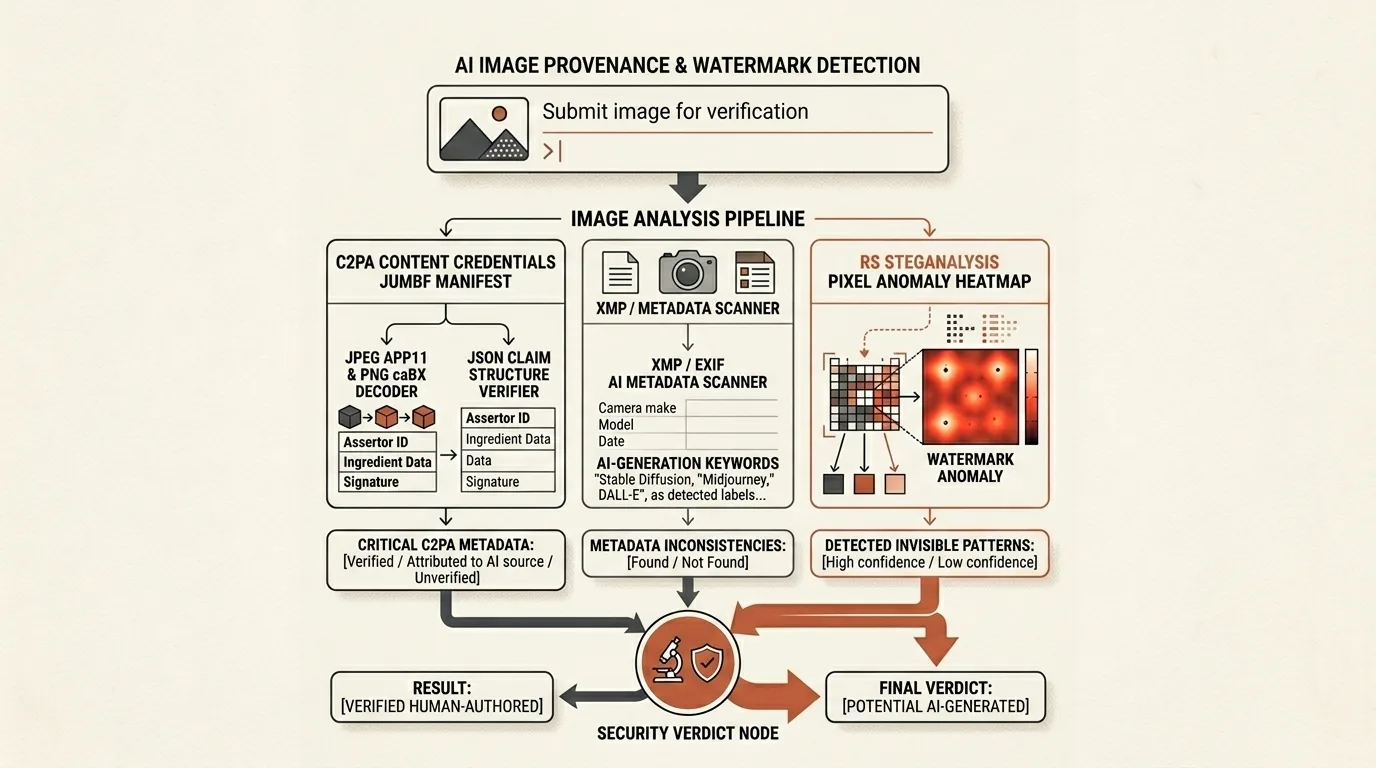
An image generated today can leave with evidence at three separate levels, made by different mechanisms with different failure modes. They get discussed as though they were one thing — "the AI watermark" — and they are not. One may be a text field. One may be a signed document. Another may be in the picture itself.
Layer one: metadata, which is a claim
The simplest marker is a string in the file header. xmp:CreatorTool saying DALL-E 3. A PNG text chunk called parameters holding the full prompt, seed, sampler and model name, which is what Stable Diffusion interfaces write by default and what makes local generations the easiest of all to identify.
The one worth knowing by name is the IPTC digital source type. It is an XMP property, Iptc4xmpExt:DigitalSourceType, and its value is an IRI ending in a token from a controlled vocabulary: trainedAlgorithmicMedia for something a model generated, compositeWithTrainedAlgorithmicMedia for a composite containing generated elements, digitalCapture for a photograph taken by a camera. It is the closest thing to a standard machine-readable "this is AI" flag, and a growing number of generators and camera makers write it.
It is also a text field. Anyone with a metadata editor can add trainedAlgorithmicMedia to a photograph or delete it from a generated image, in seconds, without touching a pixel. Metadata tells you what a file says about itself. That is genuinely useful and it is not evidence.
Layer two: C2PA, which is a signed document
Content Credentials solve the "anyone can edit it" problem the way the web solves it everywhere else: a signature. A C2PA manifest is a structured record — a claim naming the generator, a set of assertions describing what was done, thumbnails, hashes of the asset itself — wrapped in a COSE signature with an X.509 certificate chain.
It is stored as JUMBF, the JPEG box format, and where that box sits depends on the container. In a JPEG it goes into APP11 marker segments, each prefixed with the two bytes JP, a box instance number and a packet sequence number, because a manifest with a thumbnail comfortably exceeds the 64 KB a single segment can hold and has to be split across several. In a PNG it goes into a caBX chunk. In a WebP it goes into a RIFF chunk with the fourcc C2PA. Plenty of tools that claim C2PA support look only in APP1 and APP2, find nothing, and report the file as clean.
Reading a manifest and verifying one are different jobs. Reading gives you the claim: the generator, the actions, the declared source type, the names on the certificate. Verifying means checking the signature against a trust list and confirming that the hashes still match the pixels — which is what catches a manifest copied out of one file and pasted into another. Anything that only reads, including a browser tool, is reporting what the file asserts.
And the manifest is fragile by construction. It is bound to the bytes of the asset; edit the asset with something that does not understand C2PA and the binding is broken, so the sane behaviour is to drop it. Open in an editor, export, upload to a platform that re-encodes: gone. Not defeated — simply absent, indistinguishable from an image that never had one.
Layer three: the pixels, which do not wash out
SynthID takes the opposite approach. Instead of attaching a record to the file, it perturbs the pixel values themselves, in a pattern a matching detector can recognise and an eye cannot see. Because the mark is in the picture, it is designed to remain detectable after transformations that often remove the other two: re-encoding, cropping, colour adjustment, filters and screenshots.
What you can run is classical steganalysis and signal forensics, which examine several statistical and physical characteristics:
- Low-bit planes and RS steganalysis. Do the low-order bits look written to? Flip the least significant bit of a natural image and it gets locally rougher in a predictable way; flip bits that already carry a payload and it does not, and the gap between the two behaviours yields an estimated share of pixels carrying an embedded bit. Per-block RS estimates generate an interactive heatmap of localized anomalies.
- Frequency domain and 2D FFT. Mathematical 2D Fourier spectra of generative imagery often display artificial frequency harmonics: transposed convolution and upscaling layers leave characteristic periodic grids ("deconvolution artifacts"). Here, it is vital to mathematically isolate standard JPEG $8 \times 8$ block compression harmonics from anomalous generative lattice peaks, and measure the radial power spectral density slope $\alpha$ (optical camera photographs decay with power-law distribution $1/f^\alpha$ where $\alpha \approx 1.8–2.2$).
- DCT Benford's Law conformance. The distribution of the first significant digit of AC coefficients in $8 \times 8$ Discrete Cosine Transform blocks in unmanipulated photographs follows Generalized Benford's Law. Generative synthesis and tampering induce statistical divergence measured via the Kolmogorov-Smirnov distance ($D_$).
- Sensor noise residual profiling. In physical camera captures, photon shot noise varies with luminance (higher relative variance in shadows). Generative models with additive Gaussian noise or aggressive smoothing often exhibit unnaturally homogeneous noise variance across all brightness bands.
Be clear about what these estimates are worth. Heavy JPEG recompression, aggressive denoising and ordinary steganography all move the numbers. They answer "what statistical and spectral anomalies exist in these pixels", never "which commercial watermark is this".
How to interpret pixel analysis metrics
When container markers are absent or stripped, forensic analysis relies on spectral and statistical anomalies. Here is how to interpret key indicators:
What survives what
Read down the columns and the practical situation is plain. The two layers that carry a name and a signature are fragile in ordinary workflows, while a proprietary pixel mark is designed to be more resilient and needs its matching detector. Which is why the absence of readable markers means much less than people assume: after a re-encode, missing container evidence is common.
The regulation arriving in parallel does not resolve this. Article 50 of the EU AI Act requires providers to mark synthetic output in a machine-readable form, and those obligations started applying in August 2026 — but it does not mandate a single technical format, which is precisely why you find manifests, source-type fields and invisible pixel patterns in circulation at once.
What the browser tool can do
I built an AI watermark detector that inspects supported evidence in the browser without uploading the image to a server:
- Container & metadata inspection: scans EXIF fields, PNG text chunks, XMP properties, and IPTC
DigitalSourceTypevocabularies (includingtrainedAlgorithmicMediaand generator parameters). - C2PA / Content Credentials parsing: locates and reassembles fragmented JUMBF boxes across JPEG APP11 segments, PNG
caBXchunks, and WebPC2PAchunks, decoding the CBOR manifest and claim assertions (stating plainly that cryptographic signature validation is not performed in the browser). - Pixel & spectral signal forensics in a Web Worker:
- Per-channel RS steganalysis with estimated embedding rate and interactive per-block heatmap;
- 2D FFT spectrum analyzer with thermal power spectrogram visualization, radial slope $\alpha$ decay estimation, and isolation of JPEG $8 \times 8$ harmonics from non-JPEG deconvolution grid spikes;
- $8 \times 8$ block DCT Generalized Benford's Law compliance testing;
- Sensor residual noise variance homogeneity evaluation across 5 luminance bands.
- Verified re-encoding: generates cleaned JPEG, PNG, or WebP output, re-scanning the container before download and blocking the save if removable EXIF, XMP, IPTC, or C2PA evidence remains. Optional low-bit perturbation is experimental and does not guarantee removal of proprietary pixel watermarks.
- Client privacy & export: all computations run strictly on the client; supports direct cross-origin image fetching without a server proxy and full JSON diagnostic report exports.
Related tools


Frequently asked questions
How can I tell if an image was generated by AI?
Nothing tells you with certainty. Three things can tell you something: metadata fields naming the generator, a C2PA manifest attributed to the tool that made the file, and statistical traces in the pixels. The first two are commonly dropped by a re-save, and the third only produces a probability. A file with no readable markers is not proof of human origin; it only means the supported checks found no surviving evidence.
What is C2PA and where is it stored in a file?
C2PA — Content Credentials — is a signed manifest describing where a file came from: which tool made it, which edits followed, and a certificate chain over the lot. It is stored as a JUMBF box, which lives in APP11 marker segments in a JPEG, in a caBX chunk in a PNG, and in a chunk with the fourcc C2PA in a WebP. Larger manifests are split across several APP11 packets and have to be reassembled before anything can be read.
Does re-saving an image remove the AI watermark?
A conventional re-save usually drops metadata and the C2PA manifest because both live in file containers rather than in the picture. It does not reliably remove a pixel-domain watermark like SynthID, which is designed to remain detectable after recompression, cropping, colour adjustment and screenshots. Re-encoding can improve privacy from EXIF and GPS, but it does not guarantee anonymity from a watermark.
Can SynthID be detected without Google's tools?
Not identified as SynthID specifically — the detector is Google's and the key is not public. What is available is classical steganalysis: RS analysis estimates what share of pixels carry an embedded bit, and a per-block version shows where. It answers whether the low bits look written to, not who wrote them.
Does the EU AI Act require AI images to be marked?
Article 50 makes providers of generative systems mark synthetic output in a machine-readable way, and those transparency obligations started applying in August 2026. It says the mark has to be there and be detectable; it does not mandate one technical format, which is why you meet C2PA manifests, IPTC source-type fields and invisible pixel watermarks all at once, and why an image can carry all three or none.

Author
Alex RelFullstack Engineer
In commercial development since 2011 — over 15 years. Author of two SaaS products, TeleGo.io and LingvoHabit.com. The articles here come out of real client and product work.