Generative Engine Optimization (GEO): The New SEO for AI Search
Generative Engine Optimization (GEO) is work intended to make a site's information easier to find, understand and cite in AI-generated answers. For a service business, the useful outcome is qualified enquiries; citation counts alone do not establish that outcome.
This guide separates published experimental results, documented crawler controls and practical editorial recommendations. None of them guarantees that an assistant will recommend a business.
The AI Search (RAG) Retrieval Pipeline
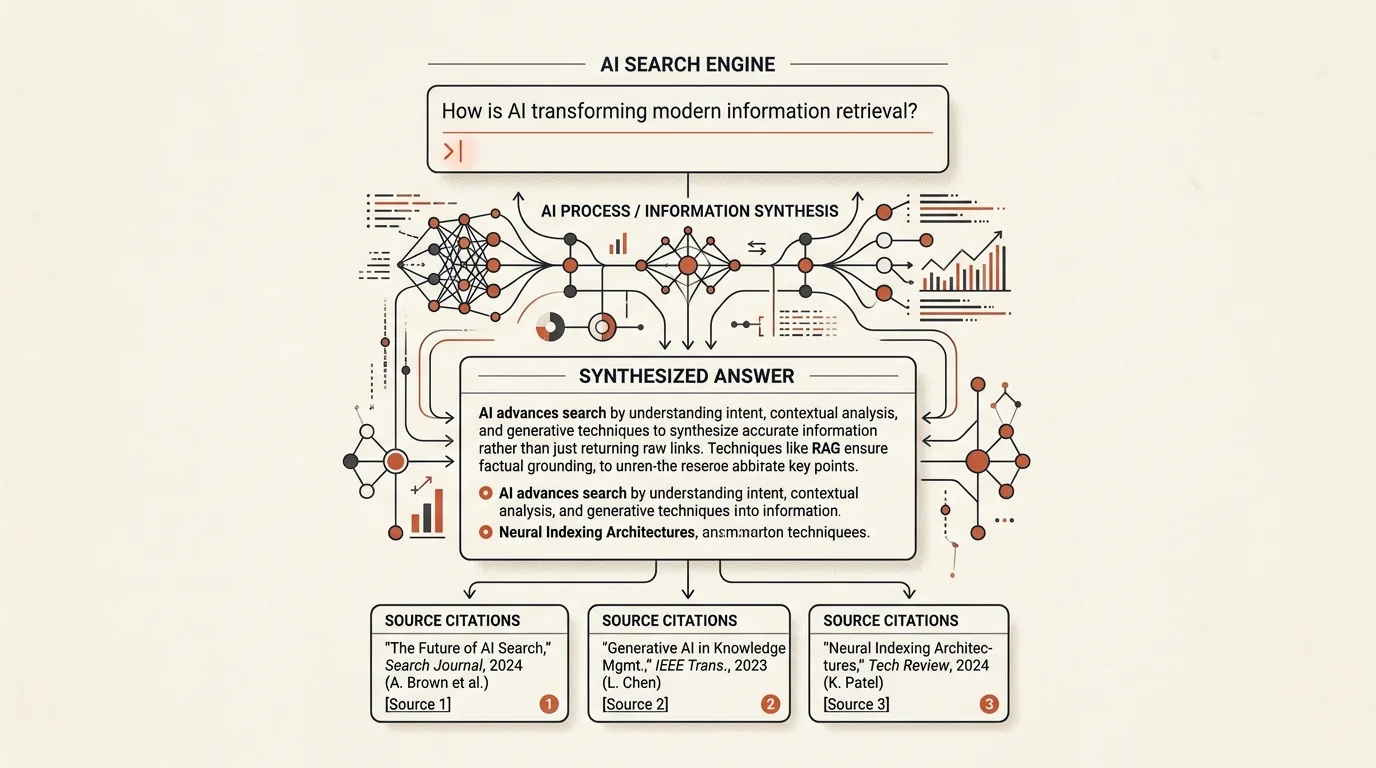
A simplified retrieval workflow looks like this:
User question
    ↓
Query reformulation and search
    ↓
Retrieval of relevant sources
    ↓
Selection of supporting passages
    ↓
Answer with source links
This is a conceptual illustration, not a specification of every vendor's system. It does not assume a fixed number of search results, mandatory embeddings or exactly three citations. Google's AI features guide describes searches across related subtopics and says that normal SEO practices remain relevant; special AI markup is not required.
Step zero: can the AI crawlers actually read you?
Check the crawler responsible for the surface you want to appear in. Training, search and user-triggered visits use different agents, and their robots.txt policies are not interchangeable.
Two mistakes follow directly from that table.
Mistake one: blocking GPTBot to "keep our content out of AI." That blocks training. It does not remove you from ChatGPT Search — that is OAI-SearchBot, a separate token. Plenty of publishers have blocked the first, kept the second open, and are surprised to still be quoted. Others blocked both and wonder why their citations vanished.
Mistake two: treating Google-Extended as a Google Search ranking control. Google distinguishes its training and grounding controls from inclusion and ranking in Google Search. Review the crawler documentation for the product you want to control.
Whether to permit training and whether to permit search retrieval are separate decisions. Blocking an agent limits the access covered by its policy; it does not guarantee that a brand will disappear from every generated answer, including answers based on third-party sources. User-triggered fetchers also have their own rules, as the OpenAI and Perplexity documentation explains.
This site allows all of them. The relevant part of alexrel.com/robots.txt:
User-agent: OAI-SearchBot
Allow: /

User-agent: Claude-SearchBot
Allow: /

User-agent: PerplexityBot
Allow: /
Check server and CDN logs for successful requests and access errors. A user-agent string alone does not prove a crawler's identity; use the vendor's published verification information where available. Missing requests in a limited log window are a reason to investigate discovery and access, not proof that the site cannot be cited.
1. What the GEO study actually measured
GEO: Generative Engine Optimization, by Aggarwal and coauthors (KDD 2024), evaluated changes to source text on GEO-bench. The experiment measured visibility within generated answers, not website traffic or the probability of being cited by today's ChatGPT.
The following values come from Table 1, the Overall column under Position-Adjusted Word Count. They are absolute metric values, not percentage increases:
The score accounts for how much of an answer is attributed to a source and where that material appears. Results depend on the metric, query category and experimental system; they are not promises of an equivalent increase in leads or search visibility for another website.
Q&A headings, original information and comparison tables can help readers. This study did not test them as separate methods named “Information Gain,” “Q&A Formatting” or “Markdown Tables.” No percentage from the study should be assigned to those recommendations.
2. Practical Technical GEO Checklist
A. Answer the reader's question directly
Use a question as a heading when it helps navigation, then answer it before adding detail. For example, “How does subscription billing work?” is clearer for a buyer than “Billing infrastructure.” This is an editorial recommendation, not a requirement to match a query word for word.
B. Link claims to their sources
Put a source next to the claim it supports. A pricing comparison should link to the relevant pricing page and state when it was checked; a research claim should identify the experiment and metric. The link lets the reader verify the claim, rather than serving as a promise of a ranking boost.
C. Make the text easy to use
Explain necessary terms and use examples, tables or lists when they make a decision easier. A readability score alone does not establish accuracy or usefulness, and padding a page to a word-count target does not add evidence.
D. Keep Your Entity Consistent Everywhere
A retrieval system has to decide that the "Alex Rel" on your site, the one in a directory listing, and the one in a conference bio are the same entity. Every inconsistency is a chance to merge you with someone else or to drop you as ambiguous.
Use a consistent name and primary URL, and include profiles you control in sameAs where appropriate. Keep the role and biography accurate. Different legitimate roles on different sites do not by themselves prove a search penalty; explain the context when a difference could confuse a reader.
E. Date Honestly
Use dateModified for a substantive update, and display the same date to the reader. Changing a date without changing the material gives a misleading impression of freshness.
The rule I follow: dateModified equals the publication date until the text actually changes, and the visible page shows an "Updated" line only when there is a real update behind it. Markup and visible content should never contradict each other — that is the same principle as an author byline that exists in JSON-LD but nowhere on the page.
3. Feeding Clean Data to AI bots using JSON-LD
JSON-LD can describe the service and provider explicitly. Keep it consistent with the visible page; it does not ensure error-free interpretation or recommendation. This example uses Service and omits an offer because a published price and its conditions must be confirmed before adding one:
{
  "@context": "https://schema.org",
  "@type": "Service",
  "@id": "https://alexrel.com/consultations#service",
  "name": "Technical Architecture Consultation",
  "description": "Professional codebase audits, database scaling reviews, and SaaS MVP planning.",
  "provider": {
    "@type": "Person",
    "name": "Alex Rel",
    "jobTitle": "Senior Fullstack Developer",
    "url": "https://alexrel.com"
  }
}
When optimizing my own projects, such as the TeleGo.io platform and the LingvoHabit language portal, I implemented these precise structural adjustments. I have observed both services cited in ChatGPT Search and Perplexity answers. That observation does not isolate the effect of markup; a reproducible case study would need the prompts, dates and saved responses.
For implementation details on robots.txt and schema structures, read my technical guide on Optimizing your Website for AI Crawlers: Robots.txt & JSON-LD.
Separate markup from search features
The presence of a schema.org type does not mean Google offers a rich result for it. Check the documented feature before promising a search benefit:
HowTo: Google stopped showing HowTo rich results on desktop on 13 September 2023, completing their removal after the earlier mobile change. See the updated announcement.FAQPage: FAQ rich results stopped appearing in Google Search on 7 May 2026, according to the documentation changelog. Useful visible questions and answers can remain.sitelinks searchbox: Google retired this search feature. Its markup should not be presented as a way to obtain it.meta name="keywords": not a Google Search ranking control.llms.txt: a proposed format for a curated site index. Google's AI features guidance does not require AI text files or special markup. Treat the file as an experiment with a specific consumer, not a general inclusion requirement.
Removing a rich result does not abolish the underlying schema.org vocabulary. Keep accurate structured data where it serves a documented purpose and distinguish that purpose from ranking promises.
4. How do you actually measure GEO?
Generated answers vary with the prompt, locale, account context and time. There is no single comparable “GEO position” across all engines. Combine observations of answers with traffic and business outcomes, and record the limitations of each:
1. Prompt sampling. Choose 15–25 questions that prospective customers ask. Separate branded queries from questions about their problem, and keep the wording, language and testing conditions consistent. Save dates, engine names, responses and cited URLs across repeated runs. A citation proves inclusion in that response, not a stable ranking.
2. Server logs. Check verified crawler requests, response codes and requested pages. A successful visit confirms access, not selection as an answer source. Cached content and third-party sources mean a citation need not correspond to a fresh request in your current logs.
3. Referrals and enquiries. Track identifiable visits from AI services and the enquiries they produce. Referrer information is not always preserved, so these visits are a partial measure; they cannot count citations that nobody clicked. Keep form success distinct from button clicks and failed submissions.
4. Search Console. Use Google's available reports to assess Google Search visibility. They do not measure citations in ChatGPT or Perplexity. For before/after comparisons, retain clicks, impressions, CTR and position, and compare the same query and page groups. A change in the mix of queries can move the overall average without changing an existing page's ranking.
5. Give people reasons to refer to your work
Relevant examples, public tools and clearly documented results give readers something concrete to cite or share. A technical explanation of a real project can be useful both on the site and in a relevant professional discussion.
Choose publications for their audience and the contribution you can make. External mentions can help people discover a business, but they are not a documented universal prerequisite for an AI citation. Evaluate individual articles and tools by useful visits and enquiries rather than increasing the number of pages or mentions for its own sake.
Sources and documentation
- GEO: Generative Engine Optimization — Aggarwal et al., KDD 2024; the study behind the strategy table above
- OpenAI crawler documentation — GPTBot, OAI-SearchBot, ChatGPT-User and what each one does
- Anthropic crawler documentation — ClaudeBot, Claude-User, Claude-SearchBot
- Perplexity crawler documentation — PerplexityBot and Perplexity-User
- Google crawler documentation — Google-Extended and its documented lack of effect on Search
- Changes to HowTo and FAQ rich results — Google Search Central, August 2023
- Google Search Central — official documentation on indexing and structured data
- Google Search documentation updates — FAQ rich result retirement in May 2026
If you want to implement GEO strategies, perform an AI search audit of your website, or optimize your content for ChatGPT and Perplexity, explore my GEO & SEO Optimization Services or book a Technical Consultation to get started.
Frequently asked questions
What is GEO in simple terms?
GEO (Generative Engine Optimization) is optimizing a website so AI engines — ChatGPT, Perplexity, Gemini — can find, cite, and recommend your brand inside their answers. Where SEO fights for a ranking position, GEO fights for a mention inside the generated answer itself.
Does GEO replace classic SEO?
No. Search accessibility, useful content and clear sourcing remain relevant. GEO also examines how a brand appears in generated answers, but no formatting technique guarantees inclusion. Requirements differ between search engines and user-triggered visits.
Which GEO techniques deliver the biggest lift?
The GEO-bench study found improvements from supporting citations, relevant quotations and statistics. Its visibility metrics describe an experimental system, not a guaranteed increase in citations or leads. The study did not measure separate gains for Q&A headings or tables.

Author
Alex RelFullstack Engineer
In commercial development since 2011 — over 15 years. Author of two SaaS products, TeleGo.io and LingvoHabit.com. The articles here come out of real client and product work.