Why Unix Time Starts on January 1, 1970
The date 1970-01-01 00:00:00 UTC has become a shared coordinate origin for Unix-like systems, programming languages, and many data formats. It does not mark the beginning of computing, nor did it arrive fully formed with the first version of Unix. Both the unit and the epoch changed several times before the developers settled on the scheme we know today.
The first Unix had a different epoch
In the First Edition Unix manual, dated November 1971, the time system call returned a 32-bit count of sixtieths of a second since January 1, 1971. That frequency matched the PDP-11 system clock, but it created an immediate limitation: the counter covered only about two and a half years.
To keep the counter usable, the early Unix developers moved its origin more than once and adjusted dates on existing files. In 1973 they adopted a more durable representation, storing whole seconds from the beginning of 1970. Moving from 60 ticks per second to one expanded the available span by roughly a factor of 60, while the new epoch remained close to the dates the system needed to represent.
The surviving historical material documents this sequence well, but it gives us no reason to turn January 1, 1970 into a symbolic date or attach an elaborate philosophy to it. It was a practical engineering decision that outlived its original hardware, became embedded in system interfaces, and grew expensive to replace as Unix spread.
What a Unix timestamp actually counts
Modern POSIX defines the Epoch as midnight on January 1, 1970 UTC and represents time as an approximate number of seconds after that point. “Approximate” matters here. The POSIX formula accounts for every calendar day as exactly 86,400 seconds, so a timestamp is not a continuous count of every physical second including leap-second insertions.
A timestamp does not contain a time zone either. The value 0 identifies one instant, but a local rendering may show the evening of December 31, 1969 west of Greenwich or the morning of January 1, 1970 to the east. Dates exchanged between systems should therefore carry their zone explicitly, with UTC normally used for an unambiguous machine value.
Strictly speaking, Unix timestamps are measured in seconds. Millisecond, microsecond, and nanosecond values are common extensions of the same convention, which means the unit should not be inferred from a generic field name. The number 1700000000 looks like seconds and 1700000000000 looks like milliseconds, but a reliable data format states the unit explicitly.
Where the Year 2038 problem comes from
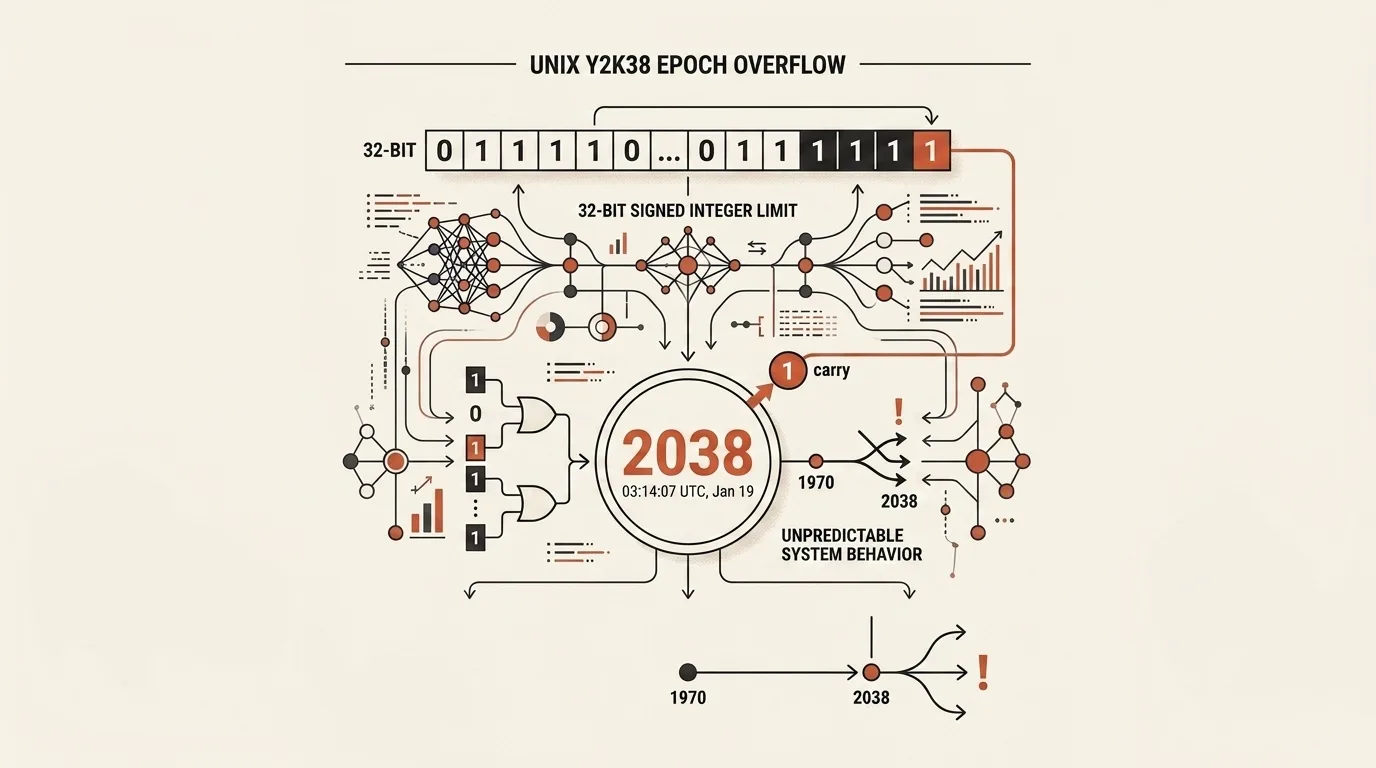
A signed 32-bit integer ranges from −2,147,483,648 to 2,147,483,647. When such a field stores seconds after the Unix epoch, its last positive value represents 2038-01-19 03:14:07 UTC; the next instant, at 03:14:08, cannot be represented in that format.
This produces the familiar Y2038 illustration. With an ordinary two's-complement wrap, the next bit pattern is read as −2,147,483,648 and points to 1901-12-13 20:45:52 UTC. That does not mean every affected device will display 1901 at exactly that second. Depending on the language, library, and operation, a program may report an overflow, sort dates incorrectly, loop a timer, or fail in some other way. The Linux time() manual therefore gives the practical rule directly: applications intended to run after 2038 need an ABI with a time_t wider than 32 bits.
The bug can surface well before the date itself. A mortgage calculation, certificate, booking, retention period, or scheduled job can already refer to an instant beyond the boundary. If any component in the path narrows the value to 32 bits, the failure happens when that future date is stored or processed, not only in January 2038.
Why moving to 64 bits is more than changing one type
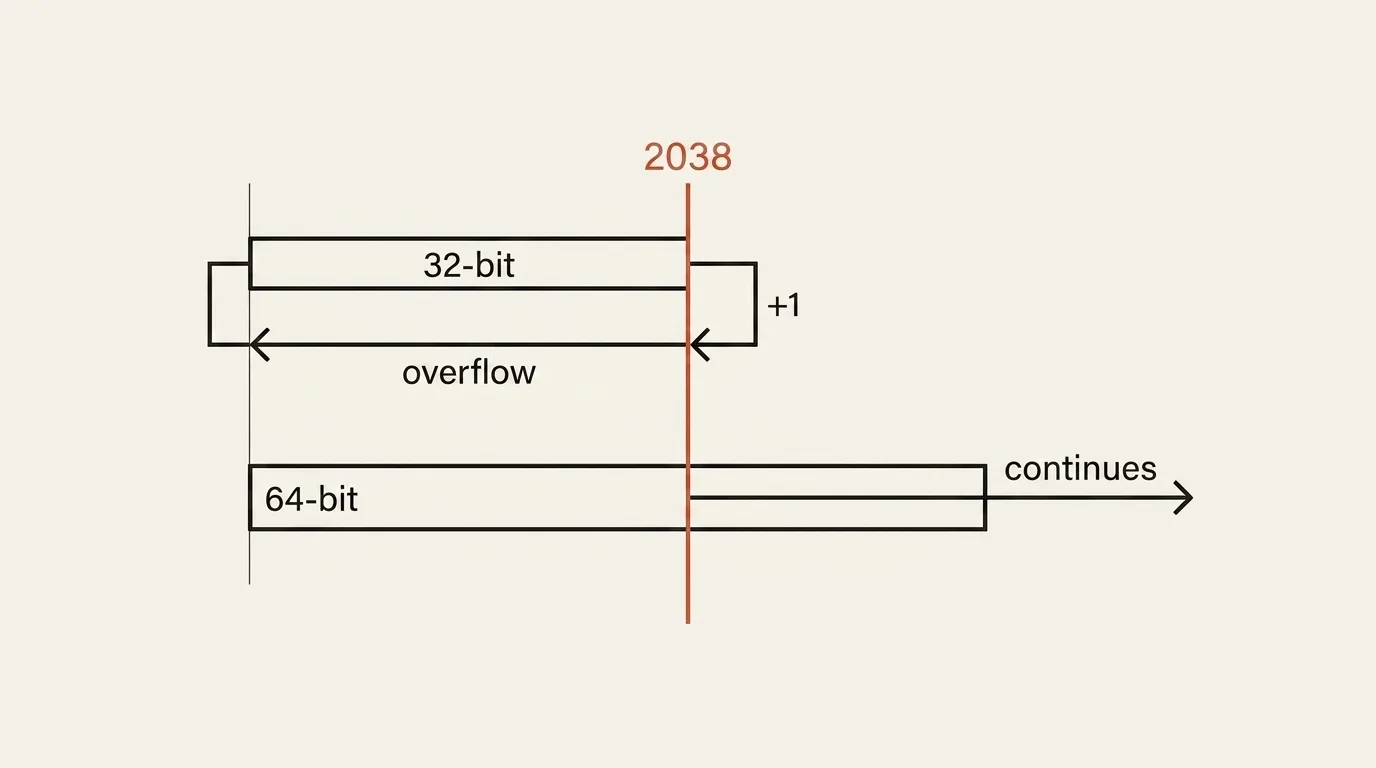
In a new POSIX.1-2024 conforming environment, time_t must be at least 64 bits wide. That range is more than sufficient for practical calendar work, but a 64-bit processor alone proves nothing: what matters is the ABI used by the program and every boundary the time value crosses.
A 32-bit Linux system, for example, can expose 64-bit time system calls while its C library provides them to applications through time64 interfaces. On traditional 32-bit glibc platforms, the _TIME_BITS=64 configuration changes time_t and the related function interfaces. It does not rewrite an existing binary, nor does it automatically widen a 32-bit field in a database, file structure, network packet, or device firmware.
A useful Y2038 audit therefore follows the date through the complete data path instead of merely looking for 32-bit hardware. It checks operating-system and library interfaces, serialization, storage schemas, and boundary handling in business logic. Tests at 2038-01-19 03:14:07 UTC, the following second, and dates much farther in the future expose both obvious overflow and silent narrowing between formats.
Using Epoch Counter
Epoch Counter brings common Unix-time operations into one local tool. Its live counter shows the current instant in seconds, milliseconds, microseconds, and nanoseconds. The final two values are explicitly marked as having millisecond precision because appending zeroes cannot create precision that the browser clock did not provide.
The converter infers a likely unit from the number of digits and accepts seconds, milliseconds, microseconds, or nanoseconds. It can display the result in UTC or local time, in human-readable and ISO 8601 forms. Conversion in the other direction accepts several common date formats; Z or GMT identifies UTC, while a string without a zone is parsed in the browser's local time.
Separate panels calculate the start and end of a day, month, or year, turn seconds into a duration, and provide common operations for twelve languages and databases, including JavaScript, Python, PHP, Go, Rust, PostgreSQL, and Shell. Everything runs in the browser, although very large inputs are still constrained by the range and numerical precision of JavaScript Date, so the tool is intended for practical dates rather than arbitrary-precision arithmetic.
For a quick boundary check, enter 2147483647 as seconds and confirm that it becomes 2038-01-19 03:14:07 UTC. Add one, and Epoch Counter in a modern browser continues to produce the correct date. This makes the central point visible: the boundary belongs to an old 32-bit storage representation, not to the calendar or the Unix epoch itself.
Related tools


Frequently asked questions
Why does Unix time start on January 1, 1970?
This was not Unix's first epoch. The First Edition manual counted sixtieths of a second from January 1, 1971. After moving the origin several times, the developers switched in 1973 to whole seconds measured from the start of 1970. Historical sources document this technical evolution but do not support the popular story of one nearly accidental choice.
What happens on January 19, 2038?
At 03:14:07 UTC, a signed 32-bit seconds field reaches 2,147,483,647. The following second no longer fits. Interpreting the wrapped two's-complement value as −2,147,483,648 produces December 13, 1901, but a real program might instead return an error, compare dates incorrectly, or fail. The outcome depends on the system.
Are all 32-bit systems vulnerable to the Year 2038 problem?
No. The relevant question is the width of the time type and the entire data path, not just the processor. A 32-bit system can use 64-bit time_t and time64 interfaces, while an old binary, file format, or network protocol with a 32-bit time field remains limited even on new hardware.
Has the Year 2038 problem been solved?
For new POSIX environments and most 64-bit systems, using a time_t of at least 64 bits removes the practical limit. Older 32-bit ABIs need time64 support in the kernel and C library, the correct application build configuration, and sometimes migrations of databases, file formats, and protocols.
Does a Unix timestamp include leap seconds?
Ordinary POSIX time is not a continuous count of atomic seconds. The standard accounts for every calendar day as exactly 86,400 seconds and leaves the relationship between system time and actual UTC during adjustments to the implementation. Unix timestamps are useful for exchanging instants, but they do not replace specialized time scales for precise scientific measurement.

Author
Alex RelFullstack Engineer
In commercial development since 2011 — over 15 years. Author of two SaaS products, TeleGo.io and LingvoHabit.com. The articles here come out of real client and product work.