From Hand Ciphers to AES: How the Security Model Changed
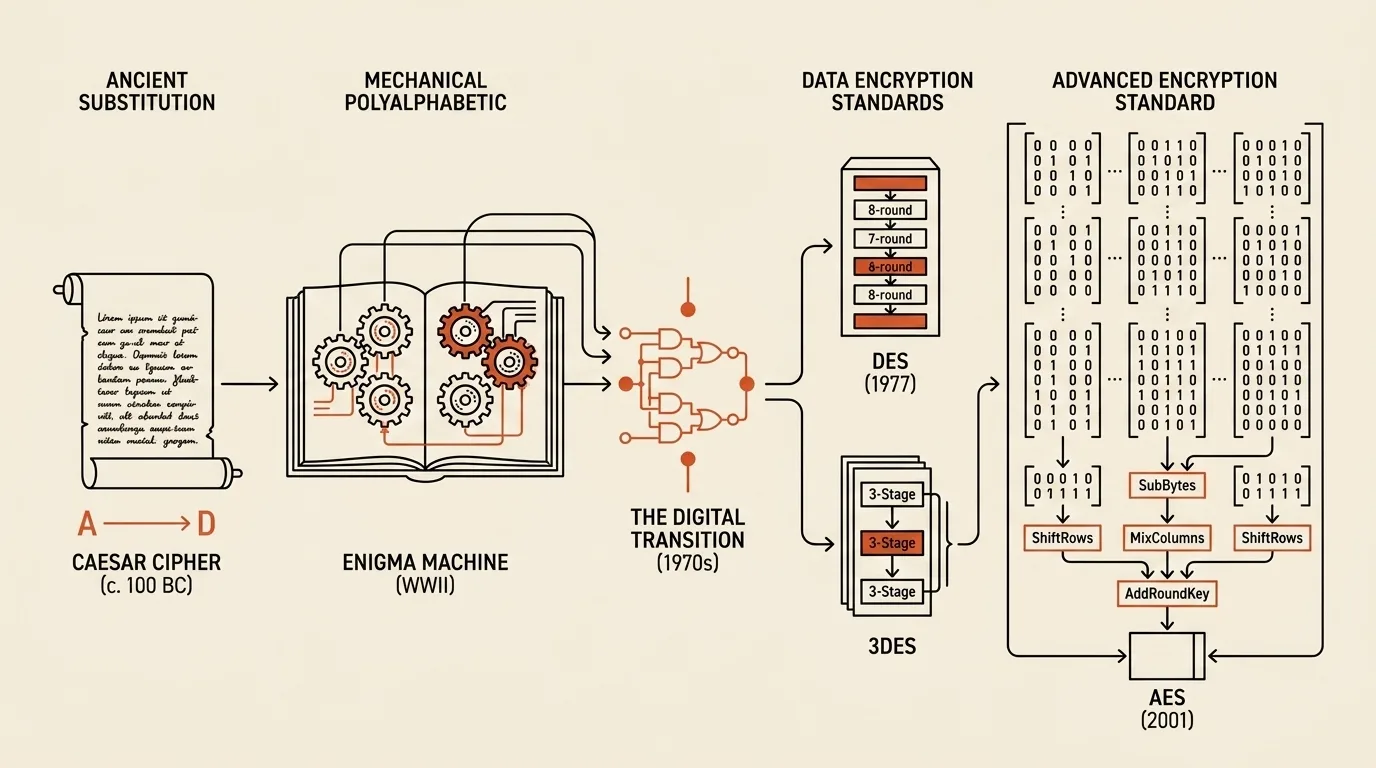
Atbash, Caesar's cipher, Enigma, and AES are often placed on one timeline as if each method simply added more complexity than the last. The task itself changed along the way. A hand cipher was meant to delay someone who intercepted a letter; a machine cipher faced organized signals intelligence, while a modern algorithm must survive public analysis, automated attack, and accidental modification in transit. The history of cryptography is therefore also a history of expanding threat models.
Fixed substitution hid text without creating a large secret
The Masoretic text of Jeremiah contains the name Sheshach, traditionally connected to Babel through a reversal of the Hebrew alphabet. The first letter exchanges with the last, the second with the penultimate, and the method's name comes from the first pairs: Aleph-Tav-Bet-Shin. An Encyclopedia of the Bible entry identifies the device as Atbash while also noting that its purpose in the passage is unclear. Babylon is named openly in the same chapter, so describing Atbash as a documented secret channel for ancient scribes goes beyond the evidence.
Atbash has no selectable key because its mapping is always the same. It can puzzle an unprepared reader, but anyone who knows the rule recovers the entire message immediately. By modern standards, that makes it a fixed transformation rather than meaningful confidentiality.
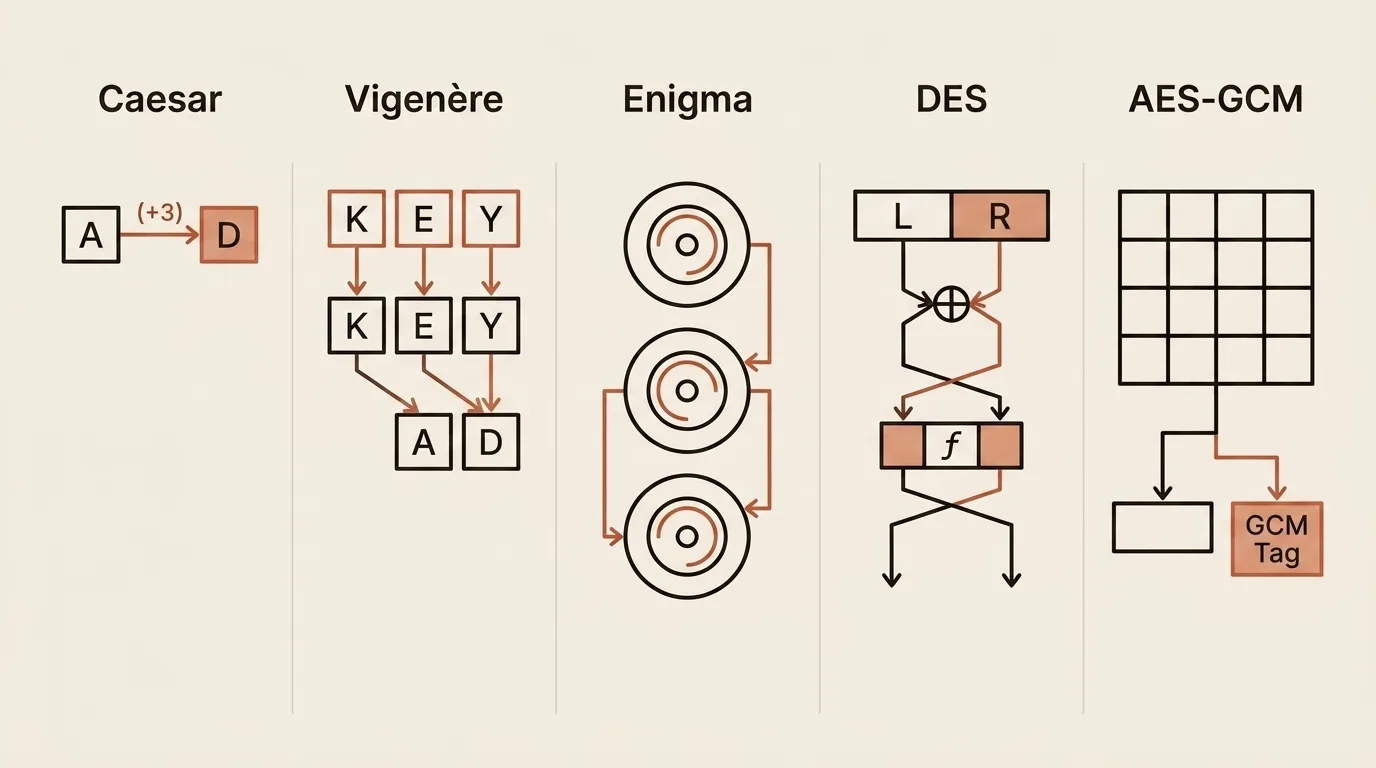
The evidence for Caesar's cipher comes from another later source. In chapter 56 of his biography, Suetonius wrote that Julius Caesar changed the order of letters in confidential correspondence so that a reader should substitute D for A. That describes a shift of three positions. Suetonius was writing in the second century CE, long after Caesar's life, but his account attached Caesar's name to an entire family of shift ciphers.
Here the secret is the shift value: E(x) = (x + n) mod m, where m is the alphabet size. The key space is small enough to enumerate completely. More importantly, the same plaintext letter always becomes the same ciphertext letter, preserving the language's frequency pattern. Merely adding more symbols would not fix that structural weakness; the next important step was to change the mapping as the message progressed.
A repeating key obscured frequencies but left a period
The system commonly called the Vigenère cipher uses a keyword whose letters select a sequence of different shifts. One plaintext letter can consequently have several ciphertext forms, so a single frequency table no longer gives a direct solution. The familiar attribution, however, hides a complicated history. Giovan Battista Bellaso published the repeating-letter key in La cifra del Sig. Giovan Battista Bellaso in 1553, whereas Blaise de Vigenère's 1586 treatise particularly developed an autokey principle. An NSA survey of Renaissance cryptography confirms that distinction, making it inaccurate to present the modern scheme as Vigenère's personal invention.
Repeating a key introduced another weakness. When the same plaintext fragment falls under the same part of the key, corresponding groups can recur in the ciphertext. Distances between those repetitions help estimate the period; the text can then be divided into several sequences, each of which once again resembles an ordinary shift cipher. Friedrich Kasiski publicly described such an approach in his 1863 book Die Geheimschriften und die Dechiffrir-Kunst.
In 1920, William Friedman published the index of coincidence, a statistic that measures the chance of drawing two identical letters from a sample. A uniform alphabet of c symbols has a baseline near 1/c; natural language differs because its letters are unevenly distributed. A simple substitution only renames characters and preserves their counts, while a polyalphabetic cipher alters the observed distribution. Splitting the text by a candidate period can expose language-like structure again when the proposed key length is correct. The NSA historical timeline dates Friedman's first publication to 1920.
None of these measurements identifies a cipher with certainty. Results vary with language, alphabet, and sample length, and repetitions also occur by chance. They work as several pieces of evidence, not as an automatic proof.
Enigma mechanized the changing alphabet
The Enigma rotor machine performed at mechanical speed what was cumbersome by hand. After every keypress, the electrical route through its rotors changed, so the next letter used another substitution. Arthur Scherbius developed an early machine in 1918, and commercial and military versions grew more elaborate over time. By the start of the Second World War, the secret included rotor choice, order and starting positions, plugboard connections, and settings that changed regularly.
The familiar account in which Alan Turing broke Enigma omits the necessary first half of the story. Marian Rejewski made the first decisive breakthrough at the Polish Cipher Bureau at the end of 1932, then developed changing-key recovery techniques with Jerzy Różycki and Henryk Zygalski. Poland gave its methods, Zygalski sheets, cryptologic bomb, and machine copies to British and French representatives in July 1939. The Polish Foreign Intelligence Agency's history documents that sequence; at Bletchley Park, Turing, Gordon Welchman, and a much larger organization extended the foundation to new machine variants and wartime interception at scale.
Their success was not simply a case of finding enough computing power. Cryptanalysis combined a mathematical model of the machine, intelligence material, predictable message fragments, procedural mistakes, and special-purpose search devices. Enigma demonstrated that a sophisticated mechanism must be evaluated together with the operating system around it.
DES turned key length into a publicly testable limit
Once computers became widespread, a cipher had to process bits, have an exact public specification, and produce compatible implementations. In 1977, the US National Bureau of Standards adopted DES as a federal standard. It transformed 64-bit blocks through 16 rounds and used 56 independent key bits; the other 8 bits in its 64-bit key representation served as parity checks.
DES resisted the best-known attacks on its round construction for years, but its key space remained finite and measurable. In July 1998, the EFF DES Cracker recovered a contest key in 56 hours. In January 1999, the same machine working with distributed.net reduced the time to 22 hours and 15 minutes. The demonstration did not show that the DES round function had suddenly failed. It showed that specialized hardware could afford to search 2^56 candidates.
AES was selected openly, but AES alone is not a complete scheme
NIST began an open process to replace DES in 1997. Researchers analyzed 15 accepted algorithms, then five finalists, before NIST selected Rijndael by Joan Daemen and Vincent Rijmen in October 2000. The design became FIPS 197 in 2001. The public competition was central to the result: confidence came from a published specification, independent scrutiny, implementation performance, and interoperability rather than secrecy about the algorithm.
AES always processes a 128-bit block and accepts 128, 192, or 256-bit keys, using 10, 12, or 14 rounds respectively. With AES-256, an initial AddRoundKey is followed by 13 rounds containing SubBytes, ShiftRows, MixColumns, and AddRoundKey; the fourteenth omits MixColumns. This exception matters because the common summary that every round contains the same four operations is technically wrong.
A block cipher alone still does not explain how to protect an arbitrary-length message. A system also needs a mode of operation, nonce rules, and an integrity check. GCM in NIST SP 800-38D is an authenticated-encryption mode: it conceals data and produces an authentication tag, causing modified ciphertext or the wrong key to fail verification. Its critical condition is that a nonce must not repeat under the same key. A sound AES primitive does not make a complete system sound when its mode, parameters, or key management are wrong.
What Encryption Toolbox demonstrates
The Encryption Toolbox brings four different activities together without making them equivalent. Cipher Identifier first looks for structural signatures of Morse, Base64, hexadecimal, JWT, ADFGX, and other formats, then uses coincidence, frequency, repetition, and candidate readability scores. Its output is a heuristic ranking. The displayed percentage is not a calibrated statistical probability, and a short or multiply transformed string can easily produce the wrong leader.
Multi Encoder runs a message through the available encodings, symbolic alphabets, classical ciphers, and one-way transformations. It decodes reversible results to mark an exact round trip, while a separate state identifies expected loss of case, spacing, or punctuation. Base64, hexadecimal, Morse, and hashes do not become encryption merely because the interface places them beside ciphers.
Cipher Workbench is designed for learning classical systems. It lets the reader change keys and alphabets, compare the Vigenère family, Playfair, Polybius, Bifid, ADFGX, transpositions, and simple substitutions, and enumerate candidates for selected methods. Those operations are useful for education and puzzles, but they do not provide modern confidentiality.
The AES tab uses the browser's Web Crypto API. It derives a 256-bit key from a password with PBKDF2-SHA256, 200,000 iterations, and a random 16-byte salt. AES-GCM receives a random 12-byte IV, while Web Crypto supplies a 128-bit authentication tag by default. The tool packs the result as salt || IV || ciphertext+tag and Base64-encodes it. Its code contains no request that sends the entered text or password to a server.
That format has practical limits. A weak password remains weak, PBKDF2 is not memory-hard, the work factor is fixed, and the output carries no format version or parameters for future migration. The tool also exposes no associated-data field and is built for text. It should therefore be treated as a local utility for messages shared with the same convention, not as a replacement for an audited protocol, a secret manager, or dedicated file-encryption software.
Related tools


Frequently asked questions
Is Atbash the oldest known cipher?
Atbash is one of the oldest known forms of systematic letter substitution. Sheshach in the Book of Jeremiah has traditionally been read as Babel produced by reversing the Hebrew alphabet, but this does not document a complete system of secret correspondence or explain why it was used. It is safer to call it an ancient cryptographic substitution than the undisputed first cipher.
What is the source for Caesar's cipher?
Writing in the second century CE, Suetonius said that Julius Caesar replaced each letter in confidential correspondence with the fourth letter following it, which amounts to a shift of three positions. This is later testimony rather than a surviving instruction written by Caesar, so the distinction matters.
Who actually invented the Vigenère cipher?
Giovan Battista Bellaso described the repeating-keyword system now commonly called the Vigenère cipher in 1553. Blaise de Vigenère's 1586 treatise developed other polyalphabetic systems, especially an autokey principle. The familiar name became attached later and is historically misleading.
Who broke Enigma?
Marian Rejewski achieved the first decisive mathematical breakthrough at the Polish Cipher Bureau in 1932 and then worked with Jerzy Różycki and Henryk Zygalski. Poland transferred its methods and machine copies to British and French specialists in July 1939. A large Bletchley Park operation, including Alan Turing and Gordon Welchman, extended that foundation during the war.
Why was DES replaced by AES?
DES has an effective 56-bit key, and by the late 1990s specialized hardware had demonstrated an affordable exhaustive search of that space. NIST held an open competition for a new 128-bit block cipher supporting 128, 192, and 256-bit keys; the winning Rijndael design became AES in 2001.
How is AES different from AES-GCM?
AES transforms individual 128-bit blocks but does not by itself define how to protect a long message. GCM is a mode of operation that uses AES for confidentiality and produces an authentication tag for integrity. GCM security requires that a nonce never be repeated with the same key.
Can Cipher Identifier determine a cipher with certainty?
No. It recognizes characteristic alphabets and formats, then ranks candidates using statistical signals. Short samples, custom alphabets, several transformations in sequence, or random data can all produce ambiguous results, so its displayed percentage is a heuristic score rather than a probability.

Author
Alex RelFullstack Engineer
In commercial development since 2011 — over 15 years. Author of two SaaS products, TeleGo.io and LingvoHabit.com. The articles here come out of real client and product work.